


Unlocking the Potential of Data: The Role of SyGra in AI Model Development
The Foundation of AI Models: Understanding Data Needs
When embarking on the journey of building AI models, particularly Large Language Models (LLMs) or Small Language Models (SLMs), the starting point is undeniably data. While a plethora of open data exists, the reality is that it often lacks the specific structure and clarity necessary for effective model training.
- The Foundation of AI Models: Understanding Data Needs
- 1. Complex Scenarios Missing
- 2. Knowledge Base to Q&A Transformation
- 3. From Supervised Fine-Tuning to Direct Preference Optimization
- 4. Depth of Questions
- 5. Domain-Specific Mid-Training
- 6. Converting PDFs and Images
- 7. Boosting Reasoning Ability
- 8. Quality Filtering
- 9. Transitioning from Small to Large Contexts
- 10. Cross-Language Conversion
- Introducing SyGra: A Comprehensive Solution for Data Challenges
- Why SyGra Matters
- Exploring SyGra Architecture
- Final Thoughts
- References
In many cases, raw datasets simply don’t cut it. They may lack depth, domain-specific context, or be misaligned with the project’s goals. Here, we explore some common challenges that data practitioners face in modifying and enhancing datasets for optimized model performance.
1. Complex Scenarios Missing
Imagine initiating your project with a straightforward dataset. As development progresses, you discover that the model struggles with advanced reasoning tasks. The question arises: how can you create more intricate datasets to enhance performance? This scenario highlights the necessity of evolving your data as the complexity of tasks increases.
2. Knowledge Base to Q&A Transformation
If you possess a robust knowledge base but it’s not formatted for Q&A, transforming it into a usable dataset becomes essential. This conversion is critical for models that rely heavily on question-answering capabilities.
3. From Supervised Fine-Tuning to Direct Preference Optimization
After gathering a supervised fine-tuning (SFT) dataset, the next logical step for alignment is using Direct Preference Optimization (DPO). But how do you generate the preference pairs needed for this process?
More Read

4. Depth of Questions
Your existing Q&A dataset might serve its purpose, but if the questions are shallow, the model’s capability will be limited. Crafting in-depth, multi-turn, or reasoning-heavy questions can lead to more robust interactions and improve overall model performance.
5. Domain-Specific Mid-Training
With a vast corpus of data at your disposal, filtering and curating information for mid-training in a specific domain is crucial. A targeted approach helps ensure that the model can achieve applicability in specialized areas.
6. Converting PDFs and Images
In this digital age, much data resides in unstructured formats like PDFs or images. For those developing Q&A systems, converting this data into structured documents is a vital step in the data preparation process.
7. Boosting Reasoning Ability
Even with reasoning datasets in place, there is always room for improvement. How can you push models toward better "thinking tokens" that facilitate step-by-step problem-solving?
8. Quality Filtering
Not all data is beneficial. Implementing automatic quality filtering is critical to eliminate poor-quality samples and retain only high-value data.
9. Transitioning from Small to Large Contexts
If your dataset has only small chunks of context, consider optimizing it for RAG (Retrieval-Augmented Generation) pipelines. This upgrade can significantly enhance the context provided to models, leading to richer interactions.
10. Cross-Language Conversion
For those working with datasets in languages like German looking to adapt them into English Q&A systems, the need for cross-language conversion can emerge. It’s essential to ensure that this transformation maintains the integrity of the data while making it accessible to larger audiences.
Introducing SyGra: A Comprehensive Solution for Data Challenges
This is where SyGra comes into play. Designed as a low-code/no-code framework, SyGra simplifies the creation, transformation, and alignment of datasets for both LLMs and SLMs. By alleviating the burden of writing complex scripts, it allows data practitioners to concentrate on prompt engineering while the framework takes care of the intricacies.
Key Features of SyGra:
- Python Library + Framework: Seamlessly integrate with existing machine learning workflows.
- Supports Multiple Inference Backends: Compatibility with vLLM, Hugging Face TGI, Triton, Ollama, and more ensures flexibility in deployment.
- Low-Code/No-Code Approach: Build complex datasets without heavy engineering effort, making data preparation accessible to broader teams.
- Adaptable Data Generation: Whether you need Q&A datasets or support for reasoning tasks, SyGra adapts to your specific use case.
Why SyGra Matters
Data is the bedrock upon which AI systems are built. The quality, diversity, and structure of your datasets often hold greater significance than mere tweaks to the model architecture. By facilitating scalable and flexible dataset creation, SyGra empowers teams to:
- Accelerate model alignment for tasks like SFT, DPO, and RAG pipelines.
- Save valuable engineering time with plug-and-play workflows.
- Bolster model robustness across complex and domain-specific applications.
- Reduce the manual effort associated with dataset curation.
For practical implementation, explore the example found at image to Q&A tutorial.
Exploring SyGra Architecture
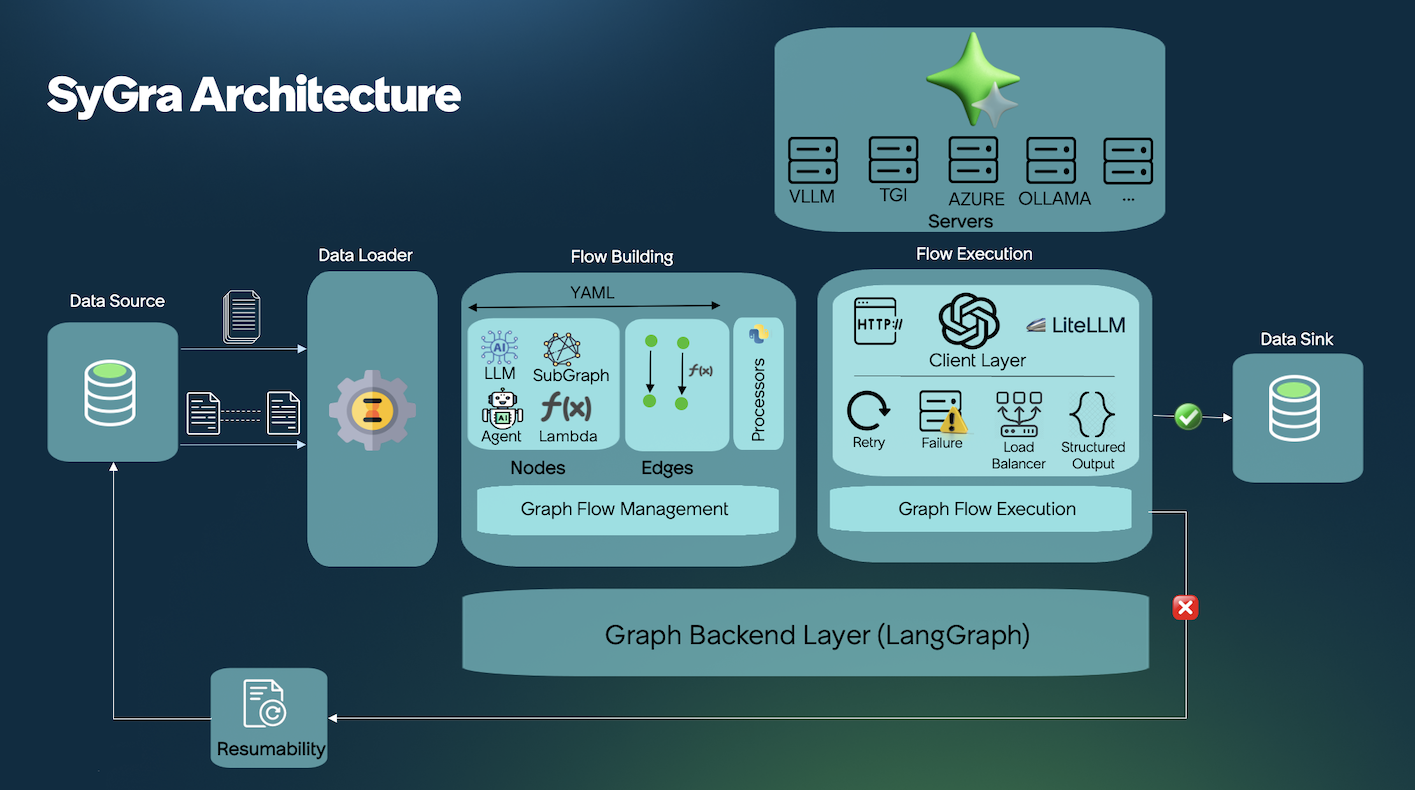
Utilize the example tasks available at SyGra’s GitHub for a hands-on experience.
Final Thoughts
The road to building and refining datasets never truly ends. As each use case presents unique challenges—ranging from translation and knowledge base conversion to reasoning enhancement and domain-specific filtering—SyGra stands as a robust solution. By offering a unified framework, SyGra allows practitioners to focus on what truly matters: the creation and optimization of intelligent AI systems.
References
Inspired by: Source


