


Accelerating Training with MXFP8: Insights from the Crusoe B200 Cluster
In the ever-evolving landscape of machine learning and AI development, performance acceleration is a focal point. Our recent work with the Crusoe B200 cluster, featuring 1856 high-powered GPUs, revealed groundbreaking findings about the MX-FP8 datatype. This innovation leveraged TorchAO’s implementation and TorchTitan to enhance training speeds while maintaining accuracy.
TL;DR: Training Acceleration Overview
Our experiments demonstrated a training speed improvement of approximately 1.22x to 1.28x when using MX-FP8 compared to the traditional BF16. Remarkably, these gains were achieved without sacrificing convergence quality.
Both performance and accuracy are crucial in AI model development, and these initial results indicate that MX-FP8 might just be the key to unlocking faster training paradigms.
Methodology: The Power of the Crusoe B200 Cluster
Using the expansive computing power of the Crusoe B200 cluster, our tests investigated the training efficiency and performance of the Llama3-70B model, utilizing HSDP2 and Context Parallel=2. This is an extension of our earlier work with Crusoe H200s, demonstrating an ongoing commitment to exploring improved training methodologies.
During the tests, we witnessed a striking 5% performance discrepancy when scaling from 4 to 188 nodes, equating to a 47-fold increase in computational capacity without significant drops in performance.
More Read

Floating Point Progression: A Brief History
Historically, we have explored different implementations of Float8, with evolving scaling precision strategies. The method began with tensorwise scaling—using one scaling factor for entire tensors—progressing to rowwise (one factor per row) and, finally, to the MX-style approach that utilizes a scaling factor for every 32 elements.
This advancement allowed DeepSeek to propose a more detailed implementation where inputs and weights are quantized using blockwise scaling. The continued evolution led us to our current implementation of MXFP8, which offers precise scaling and efficient memory usage.
The MXFP8 Advantage
Originally designed by Microsoft, MXFP8 has gained traction as an OCP standard. With its implementation on Nvidia’s Blackwell architecture, hardware support facilitates mxfp8 quantization, specifically allowing blocks of 32 elements of a tensor to be processed via a single scaling factor.
By adjusting the scaling factor precision to E8M0 (representing power of 2 scaling), MXFP8 enhances computational efficiency while maintaining fidelity.

The above comparison visualizes the difference between Float8 Tensorwise and MXFP8, highlighting the benefits of the latter in terms of processing efficiency and precision.
Performance Results: Speed Improvements and Convergence Analysis
Our performance evaluations showed impressive speed improvements across various GPU scales. Specifically, we recorded speedups from 1.22x at 1504 GPUs to 1.285x at 32 GPUs with the TorchTitan framework.

With training taking place at a massive scale, it’s essential to consider convergence as well. We observed near-equivalent convergence results when comparing the loss curves from MXFP8 to those from BF16. Notably, in some instances, MXFP8 showed slight superiority in convergence, making it a compelling choice for extensive training programs.
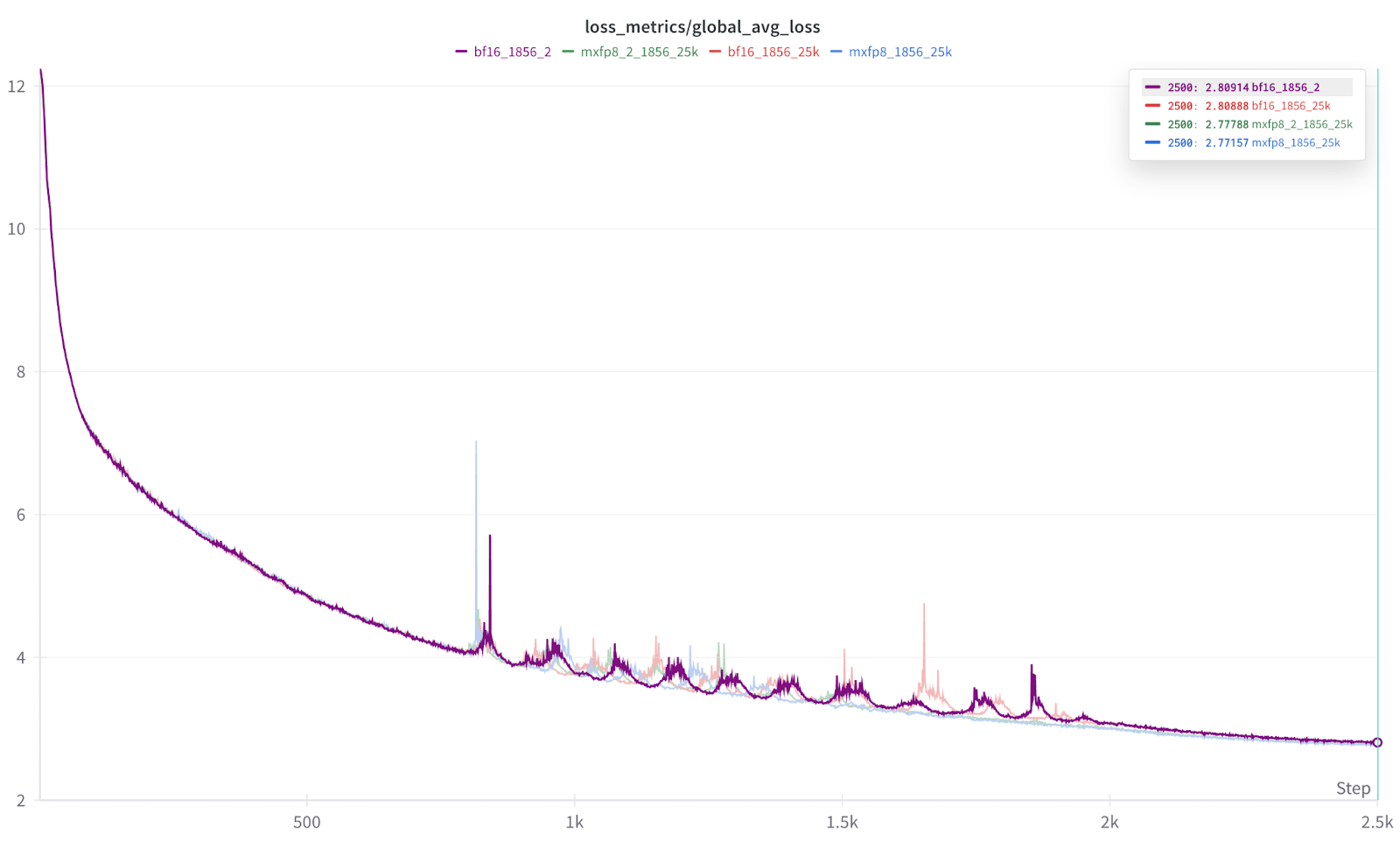
The overlay of multiple training runs indicates that results achieved with MXFP8 were consistently comparable, if not slightly better, than those accrued through BF16.
Implications for Future Research
Our exploration into the capabilities of MXFP8 is just the beginning. Testing with multiple iterations has not only confirmed the initial findings but also set the stage for further advancements. We are already witnessing more efficient speeds with kernel improvements and aim to investigate the potential of MXFP4 and NVFP4 training methodologies.
The continual refinement of algorithms and hardware will undoubtedly lead to more nuanced performance metrics and exciting possibilities for future AI endeavors.
By integrating cutting-edge technologies like MXFP8 into our training protocols, we are not merely enhancing speed; we are also paving the way for higher accuracy and more efficient models in the burgeoning field of machine learning. As we move forward, expect further enhancements and insights into maximizing GPU capabilities and training methodologies.
Inspired by: Source


