


Unlocking the Power of 🤗 Transformers for NLP: A Deep Dive into Performance Optimization
🤗 Transformers has emerged as the go-to library for data scientists and machine learning engineers worldwide. It serves as a rich resource for exploring state-of-the-art Natural Language Processing (NLP) models and developing innovative NLP features. With over 5,000 pre-trained and fine-tuned models available in more than 250 languages, 🤗 Transformers provides an accessible playground for practitioners, regardless of the framework they prefer.
However, while experimenting with these models is relatively straightforward, the challenge arises when it comes to deploying them into production environments. Achieving maximum performance and efficiently managing models in a scalable architecture is a formidable engineering obstacle for any Machine Learning Engineer. This is where Hugging Face’s hosted Accelerated Inference API comes into play, helping users achieve a remarkable 100x performance gain. But to unlock the final 10x boost, low-level optimizations tailored to specific models and hardware are essential.
In this article, we’ll explore some advanced strategies that can help you extract every ounce of computational power from your models. 🍋
Getting to the First 10x Speedup
The initial phase of performance optimization is the most straightforward. This stage focuses on leveraging the best practices and techniques available within the Hugging Face libraries, independent of the hardware in use.
At this level, efficient methods integrated into Hugging Face model pipelines help reduce computational demand during each forward pass. For instance, in a text-generation task using a GPT architecture, we can optimize the attention matrix computations by concentrating on the new attention from the last token in each pass.
More Read

To illustrate this, consider the following comparison:
| – | Naive Version | Optimized Version |
|---|---|---|
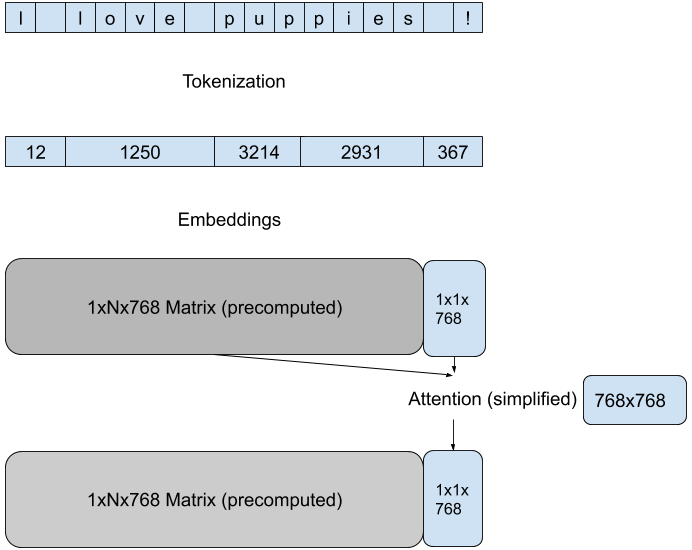 |
Tokenization often becomes a bottleneck during inference, leading to inefficiencies. By utilizing the most efficient methods from the 🤗 Tokenizers library—especially the Rust implementation of the model tokenizer combined with intelligent caching—we can achieve up to a 10x reduction in overall latency.
By taking advantage of the latest features in Hugging Face libraries, we can consistently attain a reliable 10x performance enhancement compared to a standard deployment for a specific model and hardware pairing. With regular updates to Transformers and Tokenizers, which typically arrive monthly, our API customers benefit from ongoing performance improvements without requiring constant adjustments.
Compilation FTW: The Hard-to-Get 10x
Achieving that elusive additional 10x speedup requires a deeper dive into model optimization and compilation tailored to specific hardware. The choice of hardware is critical, influenced by both the model size and the demand profile—such as request batching.
For instance, API customers using the same model may find that some benefit more from accelerated CPU inference, while others gain from accelerated GPU inference. Each scenario necessitates different optimization techniques and methodologies.
Once the compute platform is chosen, we can proceed with hardware-specific optimizations. Here are some techniques applicable to CPU environments with a static graph:
- Graph Optimization: Remove any unused flows to streamline processing.
- Layer Fusion: Combine multiple layers using specific CPU instructions to enhance efficiency.
- Operation Quantization: Reduce the precision of operations to accelerate processing speed.
It’s crucial to note that relying solely on out-of-the-box functions from open-source libraries—like 🤗 Transformers with ONNX Runtime—may not yield the best results and could even lead to accuracy loss, particularly during quantization. The journey toward optimization is unique for each model architecture, and by thoroughly examining the Transformers codebase and ONNX Runtime documentation, we can align the stars to achieve that coveted additional 10x speedup.
Unfair Advantage
The introduction of the Transformer architecture has revolutionized Machine Learning performance, particularly in NLP. Over the past three years, advancements in Natural Language Understanding and Generation have accelerated dramatically. Concurrently, the average size of models has ballooned from 110 million parameters in BERT to a staggering 175 billion parameters in GPT-3.
This trend presents significant challenges for Machine Learning Engineers tasked with deploying cutting-edge models in production environments. While achieving a 100x speedup may seem ambitious, it is essential for delivering predictions with acceptable latency in real-time consumer applications.
At Hugging Face, we enjoy a unique advantage, collaborating closely with the maintainers of 🤗 Transformers and 🤗 Tokenizers. Our strong partnerships with open-source hardware and cloud providers—including Intel, NVIDIA, Qualcomm, Amazon, and Microsoft—enable us to fine-tune our models and infrastructure using the latest hardware optimization techniques.
If you’re eager to experience this enhanced speed on our infrastructure, consider starting a free trial. For those looking to optimize inference on their own infrastructure, we invite you to participate in our 🤗 Expert Acceleration Program.
Understanding the intricacies of model deployment and optimization can significantly impact the efficiency and responsiveness of your NLP features. By harnessing the power of 🤗 Transformers, you can unlock unprecedented performance in your applications.
Inspired by: Source


