



Unlocking the Potential of Protein Language Models: A Deep Dive into ProtST
Protein Language Models (PLMs) are revolutionizing the field of bioinformatics by providing robust tools for predicting and designing protein structures and functions. At the forefront of this innovation is ProtST, a multi-modal language model introduced by MILA and Intel Labs during the International Conference on Machine Learning 2023 (ICML). This groundbreaking model utilizes text prompts for protein design and has already garnered significant attention, boasting over 40 citations in less than a year.
Understanding Protein Language Models and Their Applications
One of the standout features of PLMs is their ability to predict the subcellular location of amino acid sequences. By inputting an amino acid sequence into the model, researchers can receive instant feedback on the expected location of that sequence within a cell. This capability is crucial for various applications in synthetic biology, drug discovery, and understanding cellular processes.
Among the models available, ProtST-ESM-1b shines in its zero-shot performance, surpassing state-of-the-art few-shot classifiers. This means that ProtST can make accurate predictions without needing extensive training on specific datasets, making it an accessible and powerful tool for researchers.
Accessibility and Integration with Hugging Face Hub
Recognizing the need for accessibility, Intel and MILA have re-architected ProtST and made it available on the Hugging Face Hub. Researchers and developers can easily download the models and datasets, promoting collaboration and innovation across the scientific community. This user-friendly approach allows a wider audience to harness the potential of ProtST in their projects.
Inference with ProtST: Speed and Accuracy
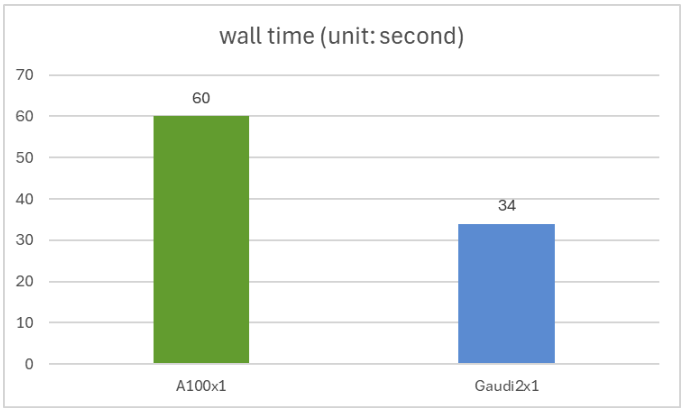
When it comes to inference, ProtST demonstrates exceptional performance. The model has been tested against the NVIDIA A100 80GB PCIe and the Intel Gaudi 2 accelerator, revealing significant advantages for researchers. Using the ProtST-SubcellularLocalization dataset, which consists of 2,772 amino acid sequences, ProtST achieved an impressive accuracy of 0.44 on both platforms, but with Gaudi 2 delivering a remarkable 1.76x faster inferencing speed.
More Read

To replicate these results, users can follow a provided script that executes the model in full bfloat16 precision with a batch size of one. The comparison of wall times for single instances of the A100 and Gaudi 2 showcases this speed advantage, allowing researchers to conduct experiments more efficiently.
Fine-tuning ProtST for Enhanced Performance
Fine-tuning is an essential practice for improving the accuracy of models, and ProtST is no exception. Researchers can specialize the model for binary location tasks—simplifying subcellular localization into binary labels that indicate whether a protein is membrane-bound or soluble.
The fine-tuning process can be executed using a straightforward script. In testing, the ProtST-ESM1b-for-sequential-classification model was fine-tuned on the ProtST-BinaryLocalization dataset, achieving an accuracy of approximately 92.5%. This level of performance closely aligns with results published in the original research, showcasing the model’s effectiveness in binary classification tasks.

The speed of fine-tuning is another area where Gaudi 2 shines, outperforming the A100 by 2.92x. Additionally, the scalability of distributed training with multiple Gaudi 2 accelerators demonstrates nearly linear growth, making it an ideal choice for extensive experiments.

Harnessing the Future of Protein Design
The introduction of ProtST marks a significant milestone in the field of protein language modeling. With its user-friendly access via the Hugging Face Hub, impressive inference speeds, and effective fine-tuning capabilities, ProtST empowers researchers to push the boundaries of protein design and understanding.
As the landscape of bioinformatics continues to evolve, the combination of advanced models like ProtST and powerful accelerators like Intel Gaudi 2 is paving the way for groundbreaking discoveries. Researchers are encouraged to explore the myriad possibilities that ProtST offers and contribute to the ongoing advancements in this exciting field.
By leveraging the resources available for ProtST, scientists can enhance their research and potentially unlock new avenues in protein engineering and biotechnology.
Inspired by: Source


