


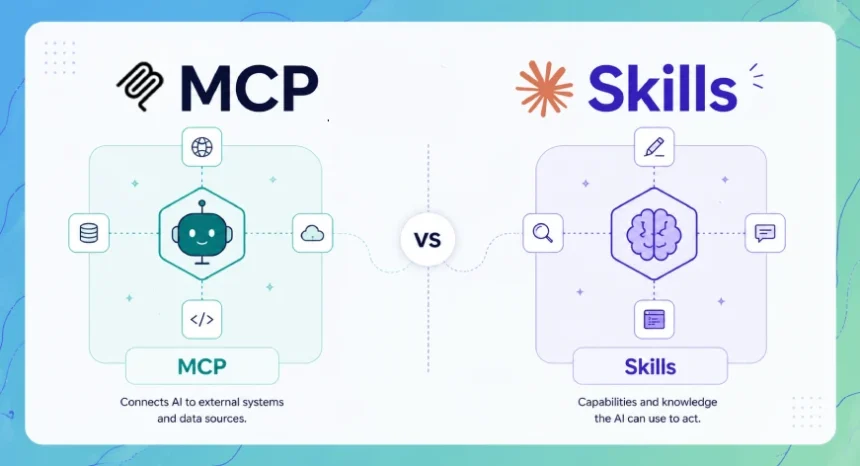
Understanding the Dynamics: MCP vs Agent Skills
There’s a lot of buzz today about choosing sides between MCP (Multi-Channel Protocol) and Agent Skills in the realm of AI. However, this narrative oversimplifies their distinct roles and functionalities. Let’s dive into the fundamental differences, usage contexts, and practical applications of these two vital technologies.
- What Are MCP and Agent Skills?
- 1. Integration: The N×M Problem vs. Trigger Mechanisms
- 2. Architecture: Services vs. File Systems
- 3. Invocation: Structured Schemas vs. Flexible Scripts
- 4. Runtime: Isolated Containers vs. Shared Environments
- 5. Where It Fits: High-Frequency vs. Lightweight Tasks
- The Bottom Line: Scaling Systems vs. Scaling Behaviors
- Frequently Asked Questions
What Are MCP and Agent Skills?
First, let’s clarify what MCP and Agent Skills actually are:
-
MCP: Think of it as a Client-Server communication protocol that standardizes interactions between agents and various backend systems. It acts as a universal bridge, allowing multiple agents to communicate seamlessly with diverse platforms.
-
Agent Skills: These represent prompt-driven instructions that guide an agent’s behavior on-demand. Similar to playbooks, they are designed to provide agents with context-sensitive operational directives.
1. Integration: The N×M Problem vs. Trigger Mechanisms
The way agents connect to their environments is where MCP and Agent Skills diverge significantly.
-
MCP (Standardized Bridge): MCP tackles the N×M problem effectively. For instance, if you have five agents each needing to interface with five different systems such as Slack, GitHub, and SQL, that could lead to a whopping 25 integrations if tackled individually. Instead, MCP enables a single server to interact with multiple agents, streamlining the whole process.
-
Agent Skills (On-Demand Knowledge): In contrast, Agent Skills focus on triggering specific behaviors. A skill, like
SKILL.md, remains in a lightweight state until a user request prompts it to load full instructions. It functions as an intelligent pull mechanism for operational directives.
2. Architecture: Services vs. File Systems
How these capabilities are structured also differs:
-
MCP (Separate Process): An MCP server operates as dedicated backend infrastructure, possibly built with languages like Python or Rust. It runs in its own environment, providing a robust and resilient connectivity option.
-
Agent Skills (Local Folders): Skills exist as simple folders on a disk, encompassing a
SKILL.mdfile for logic, ascripts/directory for execution, and anexamples/folder for additional documentation. This structure is lightweight, making it easily accessible within an agent’s immediate ecosystem.
plaintext
my-skill/
├── SKILL.md # Main instructions (required)
├── template.md # Template for Claude to fill in
├── examples/
│ └── sample.md # Example output showing expected format
└── scripts/
└── validate.sh # Script Claude can execute
More Read

3. Invocation: Structured Schemas vs. Flexible Scripts
The methods by which agents invoke capabilities illuminate further differences.
-
MCP (Typed & Chained): MCP relies on strict JSON-RPC, requiring precisely defined parameters (like strings, integers, or dates). This enables tool chaining, where the output of one tool can serve as the input for another, minimizing errors.
-
Agent Skills (Shell Execution): On the other hand, skills employ a much more flexible approach. When triggered, the agent executes commands directly in the shell (e.g.,
bash run.shorpython do.py), offering a rapid development cycle advantageous for quick automation.
4. Runtime: Isolated Containers vs. Shared Environments
Where code executes is yet another differentiator:
-
MCP (Isolated Container): MCP servers typically reside in isolated containers, establishing a security chokepoint. This architecture means sensitive information, like database credentials, remains hidden from agents, protecting your data.
-
Agent Skills (Agent’s Environment): Skills, in contrast, run directly within the agent’s environment (like local machines or cloud servers). This configuration allows for quick execution and easy access to local tools.
5. Where It Fits: High-Frequency vs. Lightweight Tasks
Understanding when to use MCP versus Agent Skills is crucial for effective system architecture:
-
MCP for Infrastructure: Utilize MCP for operations that demand high frequency and low latency—integrations with services like GitHub, Postgres, Stripe, or Slack. It serves the essential backend plumbing necessary for continuous agent functionality.
-
Skills for Behaviors: Use Agent Skills for lightweight tasks that do not rely on extensive infrastructure. They are perfect for handling brand guides, PDF extraction, CLI recipes, and document templates. This is where intelligent playbooks shine, providing the necessary behavioral guidance for agents.
The Bottom Line: Scaling Systems vs. Scaling Behaviors
It’s essential to realize that MCP and Agent Skills serve different yet complementary roles in AI architecture:
- MCP scales your systems, ensuring robust connections to various backends.
- Agent Skills scale your agent’s behavior, providing the operational knowledge needed once connected to those systems.
In 2026 and beyond, the most effective AI architects will leverage a hybrid approach—utilizing MCP for a standardized “nervous system” to interact with the world and Agent Skills to furnish the “mental playbooks” guiding operational responses.
Frequently Asked Questions
Q1. What is MCP in AI agents?
A. MCP is a client-server protocol connecting AI agents to external systems like APIs, databases, and tools.
Q2. What are Agent Skills?
A. Agent Skills are reusable prompt-based instructions guiding how an AI agent performs specific tasks or behaviors.
Q3. How are MCP and Agent Skills different?
A. MCP manages system integration, while Agent Skills define behavior and execution logic within the agent.
Q4. When should you use MCP vs. Agent Skills?
A. Use MCP for backend integrations and Agent Skills for lightweight, on-demand task execution and workflows.
Q5. Why combine MCP and Agent Skills?
A. Combining both enables scalable AI agents with robust system connectivity and intelligent task execution.
Inspired by: Source


