


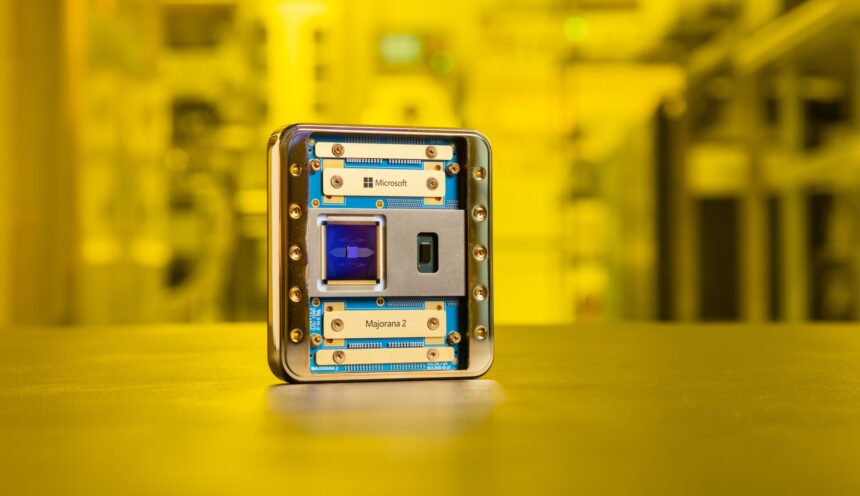
Microsoft’s Majorana 2 Quantum Chip: A Leap into the Future of Quantum Computing
This week marked a significant milestone in quantum computing with the unveiling of Microsoft’s Majorana 2 quantum chip. The announcement introduced numbers that are difficult to contextualize yet represent a groundbreaking advancement in the field: qubits that are 1,000 times more reliable than first-generation models, a remarkable mean qubit lifetime of 20 seconds (compared to industry norms measured in microseconds), and a new roadmap aiming for a commercially scalable quantum computer by 2029. Behind these impressive metrics lies Microsoft Discovery, an agentic AI platform that plays a crucial role in this achievement.
Understanding the Quantum Leap: Majorana 2
At the heart of Majorana 2’s success is its ability to maintain its fragile computational state for significantly longer than current quantum chips. While most quantum chips can only sustain this state for a fraction of a second, Majorana 2 can hold it for up to a whole minute. Microsoft uses an apt analogy: if you consider a typical smartphone battery that lasts just a day, Majorana 2’s equivalent would be a battery lasting nearly three years on a single charge. This remarkable improvement highlights the immense potential of quantum computing in real-world applications.
The Role of Microsoft Discovery Agentic AI
Contrary to some interpretations, the development of Majorana 2 was not solely the product of AI design. In fact, the pivotal decision to switch from aluminum to lead as the superconducting material was the result of years of traditional materials research, not an AI recommendation. What Microsoft Discovery’s agents efficiently accomplished was to enhance the research process surrounding these decisions.
These AI agents managed fabrication workflows, automated complex measurements that previously required weeks, and connected nearly two decades of siloed research data. By surfacing correlations and insights that would be overwhelming for a single human researcher, Microsoft Discovery effectively revolutionized the way data is handled in quantum research. As Zulfi Alam, corporate vice president for quantum at Microsoft, aptly puts it, “As you run AI agents on this data, they’re able to essentially resynthesize and make correlations that we as humans cannot see.”
Automating Qubit Measurements
One of the standout achievements attributed to Microsoft Discovery is in the domain of qubit measurement. Detecting quantum states involves determining whether there’s an even or odd number of billions of electrons on a semiconductor wire—a process that historically took weeks when done manually. Despite earlier attempts at automation utilizing initial machine learning techniques, the team struggled to achieve the desired results.
More Read

Through the capabilities of Microsoft Discovery, researchers began mapping out three-dimensional representations of qubit conditions. This allowed for the automation of the measurement process, marking a major breakthrough. “Using agentic AI to automate the measurements was a game changer,” noted Alam, illustrating how the AI efficiently handles adjustments across hundreds of parameters simultaneously—something human researchers, limited by linear thinking, simply cannot accomplish.
Microsoft Discovery Goes Mainstream
With Majorana 2 set to transform quantum computing, Microsoft Discovery has also reached general availability for enterprise customers. This platform combines specialized AI agents tailored for scientific research with a Discovery Engine designed to streamline research and reasoning workflows, all while incorporating robust security measures. Additionally, a free Microsoft Discovery app is in early preview, meant for local use in conjunction with a GitHub Copilot account.
The ambitious timeline for quantum advancements has shifted dramatically, with Microsoft’s revised target moving from 2033 to 2029. This timeline was largely influenced by the impressive progress made with Majorana 2. However, it’s essential to note that the 1,000x reliability figure specifically applies to improvements over Majorana 1 and does not directly compare to competing architectures utilized by other industry leaders like IBM or Google.
The Future of Quantum Computing
In summary, Microsoft’s Majorana 2 quantum chip heralds a new era of possibilities in quantum computing, showcasing both the advancements in the technology itself and the innovative applications of AI in research and development. The collaborative synergy between highly reliable quantum chips and cutting-edge AI platforms like Microsoft Discovery opens up exciting prospects for the future of quantum computing and its applications across various industries.
By focusing on these developments, we see not only the transformative impact of advanced materials and AI but also the promising trajectories that will likely shape the landscape of technology in the years to come. As the industry moves towards commercial scalability, the implications of these breakthroughs are set to echo through multiple sectors, redefining our understanding of computation and scientific research.
Inspired by: Source


