


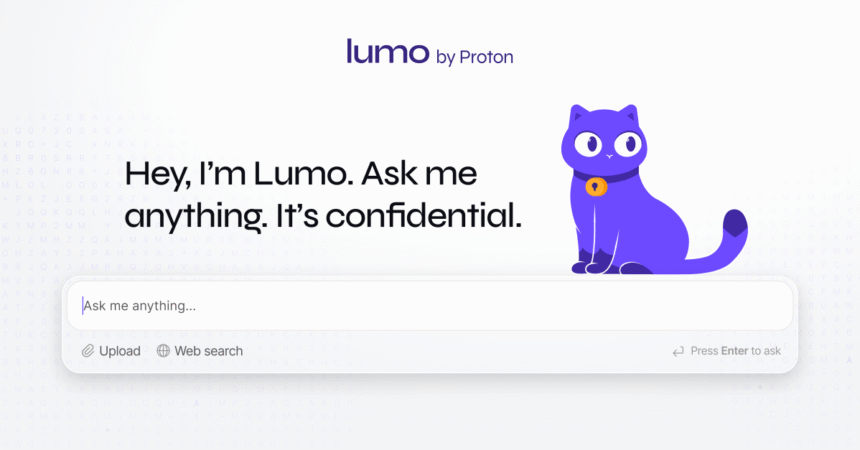
Proton Launches Lumo: A Privacy-Centric AI Assistant
Proton, the innovative company synonymous with secure communications through their encrypted email service Proton Mail, has unveiled its latest venture: Lumo, a powerful AI assistant designed with user privacy at its core. In an age where data privacy is increasingly threatened, Lumo offers a refreshing alternative for individuals who prioritize confidentiality while leveraging artificial intelligence.
What is Lumo?
Lumo is an AI chatbot that serves a multitude of purposes—including summarizing documents, generating code, and composing emails, among other functionalities. Unlike most AI services, Lumo emphasizes local data storage, keeping sensitive information on users’ devices rather than in cloud storage. This local data management is complemented by Proton’s commitment to stringent "zero-access" encryption.
Unmatched Privacy Features
Proton’s "zero-access" encryption is a game-changer in the realm of data privacy. With this feature, users receive an encryption key that grants them exclusive access to their content. Consequently, no third parties, including Proton itself, can view this information. As a result, Proton can confidently assert that they won’t share user data with advertisers or government entities, nor will they utilize it for training large language models. This dedication to privacy underscores Proton’s commitment to protecting user data in an era of rampant data exploitation.
Lumo’s Web Searching Capabilities
While Lumo is equipped with the ability to search the web, Proton has strategically disabled this feature by default to maximize user privacy. Users can choose to enable web searches, but even then, Lumo utilizes "privacy-friendly" search engines. Furthermore, Lumo can analyze uploaded files, but it never saves any data from these interactions, ensuring that user confidentiality is never compromised. For a more seamless user experience, individuals can link their Proton Drive files to Lumo, allowing for interactions that remain fully end-to-end encrypted.
A Different Approach to AI
Proton positions Lumo as a direct alternative to AI offerings from tech giants like OpenAI’s ChatGPT, Meta AI, Google’s Gemini, and Microsoft Copilot. Andy Yen, CEO and founder of Proton, emphasizes a fundamental difference in their approach, stating, “Big Tech is using AI to supercharge the collection of sensitive user data." By contrast, Proton’s vision for Lumo is to prioritize user needs over profit, creating an environment where users can feel safe while harnessing AI capabilities.
More Read

Advanced Technology Behind Lumo
Lumo is powered by several open-source large language models, including Mistral’s Nemo and Mistral Small 3, Nvidia’s OpenHands 32B, and the Allen Institute for AI’s OLMO 2 32B model. Depending on the type of query, Lumo intelligently selects the most appropriate model for the task. For instance, queries related to programming are directed to OpenHands, which specializes in coding tasks, thereby ensuring that users receive accurate and helpful responses.
Accessing Lumo
Eager users can begin utilizing Lumo immediately by visiting lumo.proton.me or by downloading the Lumo app, available for both iOS and Android platforms. New users without a Proton account can ask a limited number of questions weekly but will not have access to chat histories. On the other hand, users with a free Lumo account can view encrypted chat histories, upload small files, and favorite a limited selection of chats.
For those seeking a more immersive experience, Proton offers a Lumo Plus subscription plan at $12.99 per month. This plan provides users with unlimited chat capabilities, extended encrypted chat history, the ability to favorite more chats, and the option to upload larger files.
Proton’s Lumo is not just another AI assistant; it represents a significant advancement towards privacy-focused technology in a landscape dominated by data-driven strategies. With features designed to protect user information and an ethical vision that counters the prevailing trends in tech, Lumo paves the way for a future where AI and user privacy can coexist harmoniously.
Inspired by: Source


