


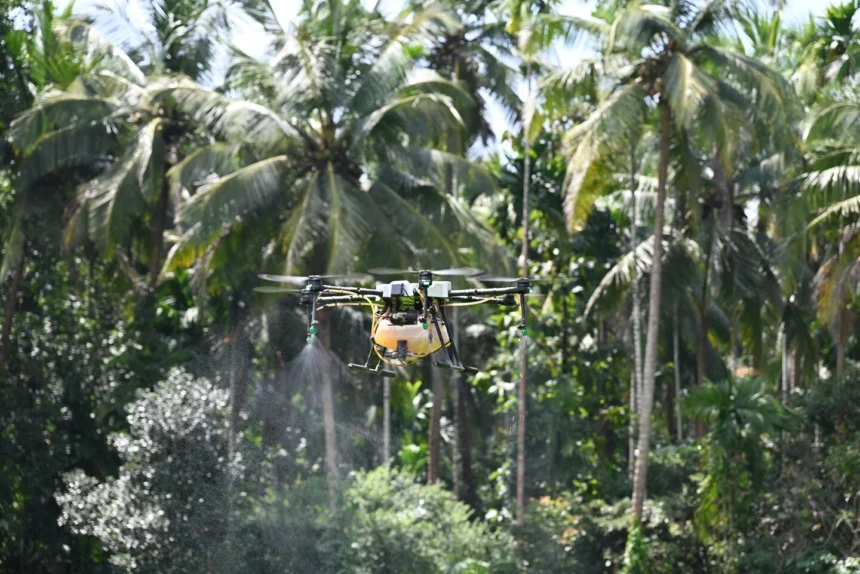
GEODASH Aerosystems: Revolutionizing Agricultural Spraying with Advanced Drone Technology
Introduction to GEODASH Aerosystems
In a groundbreaking venture, Singapore-based DroneDash Technologies has partnered with GEODNET to establish GEODASH Aerosystems, aimed at transforming the landscape of agricultural spraying. Their innovative approach focuses on the development of an advanced agricultural spraying drone specifically designed for large industrial farms, particularly targeting the complexities of modern farming practices.
- Introduction to GEODASH Aerosystems
- Addressing the Limitations of Current Agricultural Drones
- Innovative Drone Technology at GEODASH
- The Importance of Real-time Decision Making in Agriculture
- Operating Within Geo-fenced Boundaries
- Continuous Adaptation to Environmental Changes
- Dual Functionality: Aerial Sensor and Spray Applicator
- Target Markets and Future Developments
- Insights from Industry Leaders
- Closing Thoughts
Addressing the Limitations of Current Agricultural Drones
Traditional agricultural spraying drones are often adaptations of general-purpose models, leading to inefficiencies in large-scale farming operations. Farmers have historically needed to meticulously map each field, generate detailed flight plans, and repeatedly adjust those plans as ground conditions change. These processes can be time-consuming and hinder the operational efficiency of agricultural teams, particularly on vast estates like palm oil plantations where crops are organized in rows.
Innovative Drone Technology at GEODASH
GEODASH’s drone technology is engineered to eliminate the need for pre-flight mapping and the constant re-evaluation of conditions. This revolutionary aircraft is designed to autonomously perceive its surroundings in real time during flight. This capability allows it to adjust its behavior based on the visuals it captures, offering superior adaptability for crop spraying operations.
The combination of DroneDash’s AI vision system and GEODNET’s positioning correction technology promises to achieve positional accuracy down to one centimeter. This allows for real-time interpretation of rows, trees, terrain, and operational zones, permitting instant adjustments to altitude and spray rates based on varying conditions.
The Importance of Real-time Decision Making in Agriculture
Agriculture is inherently unpredictable. Unlike structured environments like assembly lines or warehouses, agricultural land is a dynamic landscape with mixed-age crops and evolving plant growth. Drones need to make real-time decisions based on their environment, requiring a sophisticated blend of perception and location awareness.
More Read

This advancement in drone technology signifies a shift towards more intelligent machinery that can autonomously respond to alterations in the field, as opposed to relying solely on deterministic systems that can be cumbersome in unpredictable scenarios.
Operating Within Geo-fenced Boundaries
While GEODASH’s drones will not function as fully autonomous systems capable of indefinite operation across agricultural properties, they are designed to work efficiently within geo-fenced areas. Each drone will log its operational decisions, allowing human operators to analyze and refine next steps for maximum effectiveness.
This logging capability ensures that any deviation from expected outcomes can be reviewed and adjusted, bridging the gap between automation and human oversight while enhancing operational efficiency.
Continuous Adaptation to Environmental Changes
The nature of farming—affected by factors like replanting, soil erosion, and seasonal changes—means that static maps can become obsolete quickly. The drones developed by GEODASH are intended to be redeployed swiftly as environmental changes occur, providing a more reliable solution for modern farmers than those reliant on outdated mapping data.
Dual Functionality: Aerial Sensor and Spray Applicator
One notable advantage of GEODASH’s drones is their dual functionality. Beyond merely applying sprays, these drones act as aerial sensor platforms. Each flight generates valuable data that can inform farmers about canopy density, crop health, and spray effectiveness.
This ongoing data collection can help farmers optimize various aspects of their operations, from adjusting dosage levels and treatment timings to determining when replanting or pest control measures are needed. This evolving feedback loop empowers growers to make more informed decisions throughout the farming cycle.
Target Markets and Future Developments
GEODASH is initially focusing its technology on palm oil plantations in Southeast Asia, row-cropping operations in the U.S., and large estates across South America. The companies are currently running pilot deployments and validation projects that extend throughout 2025 and into early 2026. Commercial deployment is anticipated for the third quarter of 2026, marking a significant step towards smarter agricultural practices.
Insights from Industry Leaders
“Agriculture does not need bigger drones – it needs smarter ones,” stated Paul Yam, CEO of DroneDash Technologies and GEODASH Aerosystems. This philosophy embodies the company’s commitment to pushing the envelope of what is possible in agricultural technology.
Closing Thoughts
The collaboration between DroneDash Technologies and GEODNET through GEODASH Aerosystems symbolizes a major leap forward in the agricultural sector. By combining innovative drone technology with advanced AI systems, this joint venture aims to streamline agricultural practices, improve efficiency, and ultimately support sustainable farming methods through smart, adaptive solutions.
Inspired by: Source


