


Transforming Outage Management: The Power of Google Cloud’s AI-Powered Gemini CLI
In today’s tech landscape, minimizing downtime is a top priority for Site Reliability Engineers (SREs). A recent article by Google Cloud SREs sheds light on their innovative use of the AI-powered Gemini CLI to tackle real-world outages effectively. This advanced approach not only boosts reliability in essential infrastructure operations but also significantly shortens incident response times by integrating intelligent reasoning directly into terminal-based operational tools.
The Role of Gemini CLI in Outage Management
The Gemini CLI, built on the cutting-edge Gemini 3 architecture, plays a pivotal role in assisting teams throughout every stage of an outage. From classification to initial mitigation, root-cause analysis, and automated postmortems, this tool enhances the efforts of SREs, aiming to reduce the Mean Time to Mitigation (MTTM). The focus here is on speed; as Riccardo Carlesso, developer advocate at Google, notes, “We obsess over MTTM.” This metric emphasizes how swiftly a team can alleviate user pain rather than just focusing on complete repairs (MTTR).
“Unlike Mean Time to Repair (MTTR), which focuses on the full fix, MTTM is about speed: how fast can we stop the pain?”
Stages of Incident Response with Gemini CLI
Incident handling generally unfolds through four distinct phases: paging, mitigation, root cause analysis, and the postmortem review. The Gemini CLI enhances each phase of this lifecycle, helping to keep MTTM low. Starting with initial paging and investigation, it allows for efficient symptom classification and selection of appropriate mitigation strategies.
This is where the Gemini CLI excels as a large language model (LLM): “Classify the symptoms and select a mitigation playbook.” These playbooks, crafted dynamically, provide detailed instructions for agents that facilitate safe production changes. They outline not just the commands to run, but also steps to verify the effectiveness of changes or a rollback if necessary.
“These playbooks can include the command to run, but also instructions to verify that the change is effectively addressing the problem, or to rollback the change.”
The Importance of Human Oversight
Despite the advanced capabilities of the Gemini CLI, human verification of proposed mitigations remains a critical component. As technology evolves, this reliance on human oversight may diminish, yet the need for explicit safety checks remains paramount. Certain actions that are safe in one context could lead to complications in another. Therefore, layered safety controls must remain in place, ensuring SREs are adequately supported without ceding complete control.
“No matter what stage we are at right now, we should always stay accountable and never give up on critical thinking.” – Wen-Tsung Chang, senior infrastructure engineer at Houzz
Root Cause Analysis and Long-Term Fixes
After overcoming the immediate issues, the focus shifts to identifying the root cause and determining a long-term solution. In an example scenario, once the infrastructure health is verified, the focus can shift toward the application logic, guiding the agent to the relevant source code for deeper analysis. This stage is crucial for preventing future incidents, ensuring that the initial problem doesn’t recur.
Simplifying Postmortems with Gemini CLI
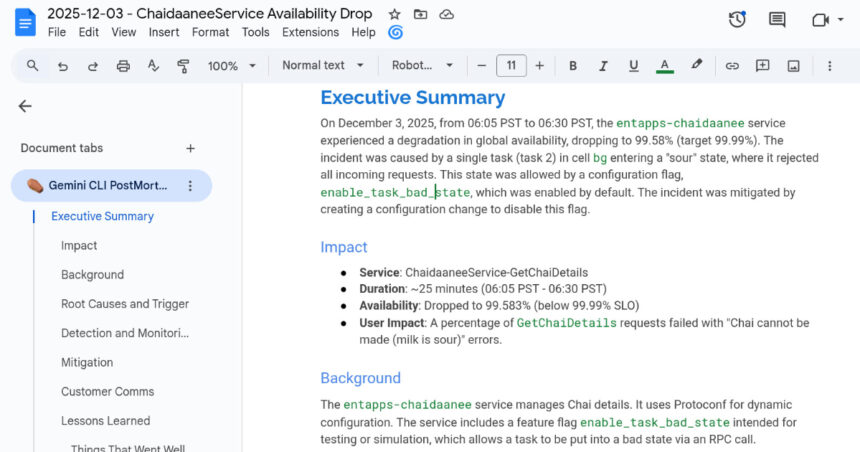
The postmortem phase, often viewed as tedious due to the extensive data collection requirements, becomes significantly streamlined with the Gemini CLI. This tool automates the aggregation of timelines, logs, and actions taken during the incident. By using a custom command to scrape all relevant data, Gemini can populate a CSV timeline and recommend action items to prevent similar issues in the future.
“Perhaps the most exciting part is what happens next. That Postmortem we just generated? It becomes training data.”
Creating a Feedback Loop for Continuous Improvement
The outcomes of these postmortems can be fed back into the Gemini system, creating a self-improvement loop where today’s investigations inform tomorrow’s solutions. This allows teams to learn from past mistakes proactively, continuously refining their incident management processes.
Integrating Gemini CLI with Other Tools
A comprehensive workflow can be constructed using the Gemini CLI in conjunction with managed cloud platform (MCP) servers. By connecting to tools like Grafana, Prometheus, and PagerDuty, teams can enhance their operational capabilities. Custom slash commands further facilitate interactions with the Gemini CLI, making it easier to execute complex operations efficiently.
Inspired by: Source


