


In the rapidly evolving landscape of artificial intelligence, training increasingly smarter models stands as an essential milestone for scaling intelligence. Success in this domain hinges on groundbreaking advancements across multiple realms, including GPUs, CPUs, Networking Interface Cards (NICs), and innovative software algorithms. Industry players are racing to deliver immense performance capabilities required for modern AI applications.
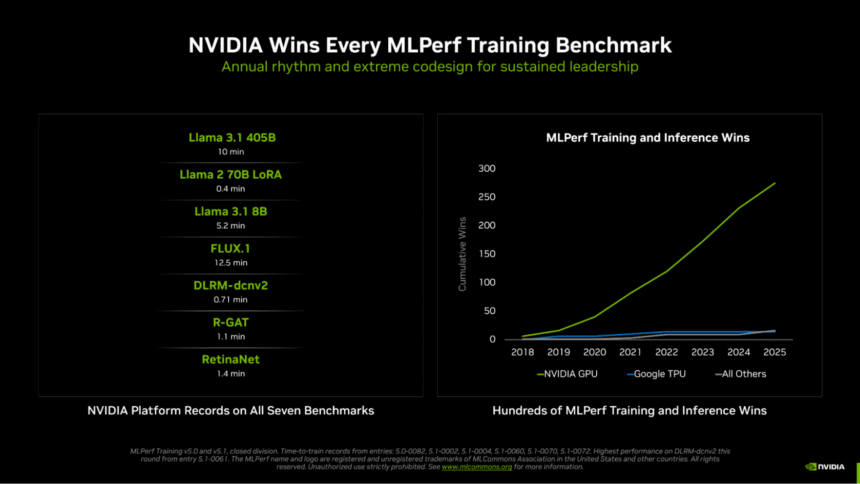
NVIDIA recently showcased its unparalleled prowess in the field during the MLPerf Training v5.1, a recognized series of standardized AI training benchmarks. NVIDIA didn’t just participate; it dominated, emerging victorious in all seven tests, which included large language models (LLMs), image generation, recommender systems, computer vision, and graph neural networks. This impressive achievement signals NVIDIA’s commanding lead in AI model training performance.
Further cementing its dominance, NVIDIA was the sole platform to submit results across every single test, a testament to the impressive programmability of its GPUs and the versatility of the CUDA software stack. This multifaceted approach enables developers to push the boundaries of what’s possible in AI development.
NVIDIA Blackwell Ultra Takes Center Stage
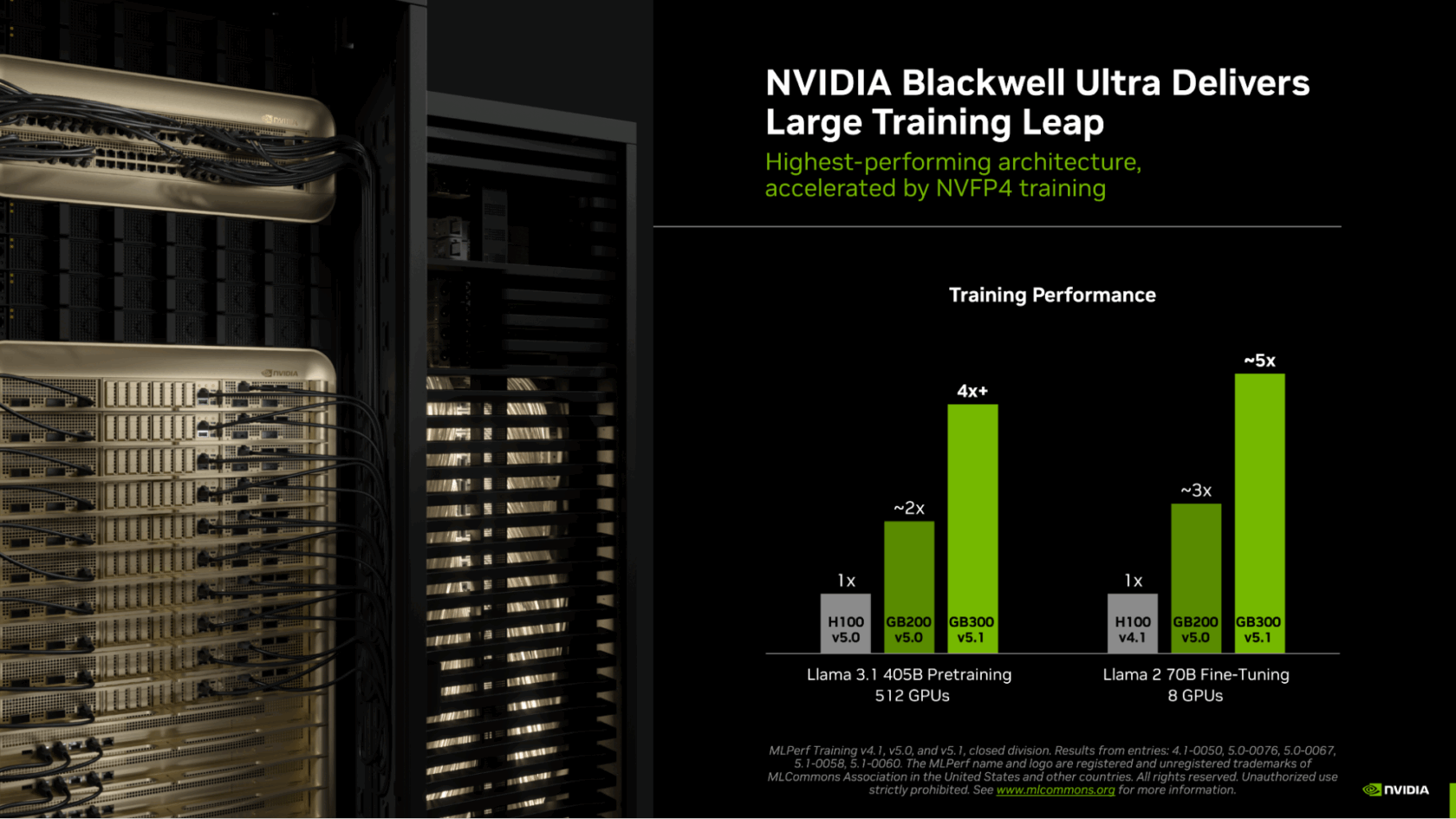
Among the groundbreaking technologies debuted was the GB300 NVL72 rack-scale system powered by the NVIDIA Blackwell Ultra GPU architecture. Following a record-setting display in a previous MLPerf Inference round, this system significantly outperformed the prior-generation Hopper architecture. In fact, it delivered over 4x the performance during Llama 3.1 405B pretraining, and nearly 5x for Llama 2 70B LoRA fine-tuning, all while utilizing the same number of GPUs.
The Game-Changer: NVFP4 Enhanced Training
The impressive results in this edition of MLPerf can largely be credited to the use of NVFP4 precision—an unprecedented move in the benchmark’s history. By employing calculations with reduced bit representations, Nvidia was able to increase compute performance while ensuring accuracy through careful design considerations. The Blackwell GPU architecture allows for FP4 calculations at double the rate of previous FP8 computations; Blackwell Ultra amplifies that to a staggering three times, leading to notable enhancements in AI performance.
NVIDIA stands as the only platform to fulfill MLPerf Training’s stringent accuracy requirements while leveraging FP4 precision in its calculations. This groundbreaking achievement demonstrates the company’s relentless innovation in AI training methodologies.
Record-Breaking Times for Llama Models
NVIDIA recently set a striking new record for training Llama 3.1 405B models, accomplishing the task in a mere 10 minutes thanks to a coordinated effort involving over 5,000 Blackwell GPUs. This feat marks a 2.7x increase in speed compared to the previous record submitted in an earlier round, illustrating the considerable benefits of both GPU scaling and NVFP4 precision.
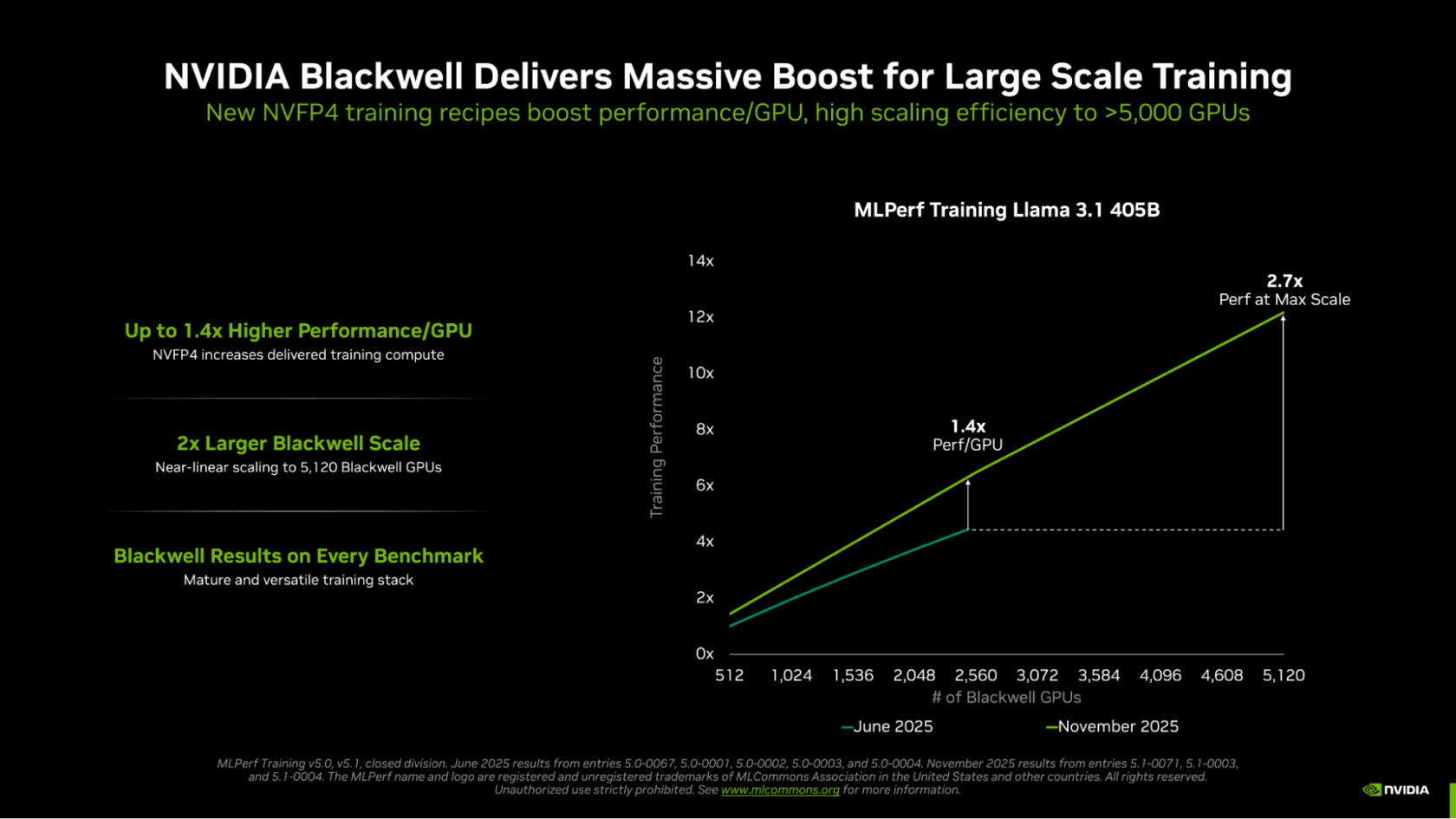
NVIDIA further demonstrated the system’s potential by using 2,560 Blackwell GPUs to train Llama 3.1 in just 18.79 minutes, marking a performance improvement of 45% over prior submissions. This showcases the efficiency gains realized through optimized GPU coordination and the innovative use of NVFP4 precision.
Setting New Standards with Llama and FLUX Benchmarks
The introduction of two new benchmarks in this MLPerf round also saw NVIDIA setting new records. The Llama 3.1 8B model replaced the long-standing BERT-large model, establishing a fresh benchmark standard. NVIDIA’s results placed it at an impressive 5.2 minutes for training using up to 512 Blackwell Ultra GPUs.
Additionally, the new FLUX.1 model for image generation replaced Stable Diffusion v2, with only NVIDIA submitting results for this benchmark. Utilizing 1,152 Blackwell GPUs, the company achieved a record training time of just 12.5 minutes.
NVIDIA’s commitment to setting new benchmarks extends across existing tests as well, as it continues to hold records in graph neural networks, object detection, and recommendation system benchmarks.
A Vibrant Partner Ecosystem
NVIDIA’s recent achievements are deeply rooted in its extensive ecosystem, which featured compelling contributions from 15 organizations including industry giants like ASUSTeK, Dell Technologies, and Hewlett Packard Enterprise. This collaborative environment fosters innovation and provides a platform for joint advancements in AI solutions.
The rapid pace of innovation at NVIDIA demonstrates an unyielding commitment to performance enhancements across pretraining, post-training, and inference stages. As the AI landscape continues evolving, these advancements not only pave the way for new technologies but also accelerate the adoption of AI solutions in various sectors.
For more in-depth NVIDIA performance data, you can visit the Data Center Deep Learning Product Performance Hub and the Performance Explorer pages.
Inspired by: Source


