


A car pulls up to the curb. The app says, “Your ride is here.” No one’s in the driver’s seat. This scenario is already a reality for individuals living in various cities that now host robotaxi services. With the rapid evolution of technology, the robotaxi industry has transitioned from concept to practical application, marking the dawn of a new era in transportation.
Recent developments highlighted at NVIDIA GTC Taipei demonstrate that the robotaxi sector is gaining momentum, with numerous collaborations aimed at expanding its global footprint. The following are some notable partnerships making waves in the industry:
- Uber and Autobrains are set to launch a robotaxi program in Munich using the NVIDIA DRIVE Hyperion platform, enhanced by Autobrains’ innovative AI to support scalable operations.
- Foxconn is enhancing its collaboration with NVIDIA to deploy robotaxi fleets in Taiwan, combining services with NVIDIA DRIVE Hyperion for rapid integration and scaling.
- VinFast is joining forces with Autobrains to deliver level 4 vehicles built on NVIDIA DRIVE Hyperion to the Southeast Asian market.
- HUMAIN is working to introduce DRIVE Hyperion-powered robotaxis in Saudi Arabia, marking an exciting expansion into the Middle East.
Building a Safe Software Foundation
As the robotaxi sector grows, ensuring safety is non-negotiable. Various stakeholders, from regulators to developers, are meticulously evaluating what constitutes safe deployment on a large scale. While discussions around level 4 autonomy often highlight a vehicle’s ability to perceive and make decisions, it’s crucial to remember that this is just one facet of a broader picture.
Safety goes beyond perception and decision-making; regulators are now seeking proof of reliable performance that sufficiently isolates potential faults, preventing them from escalating into serious issues. The comprehensive safety framework of robotaxi operations hinges on addressing four specific challenges simultaneously:
- A safety-certifiable operating system
- Standardized hardware and software interfaces that prioritize safety
- AI functionality confined within verifiable guardrails
- Thorough validation at scale before vehicles are utilized on public roads
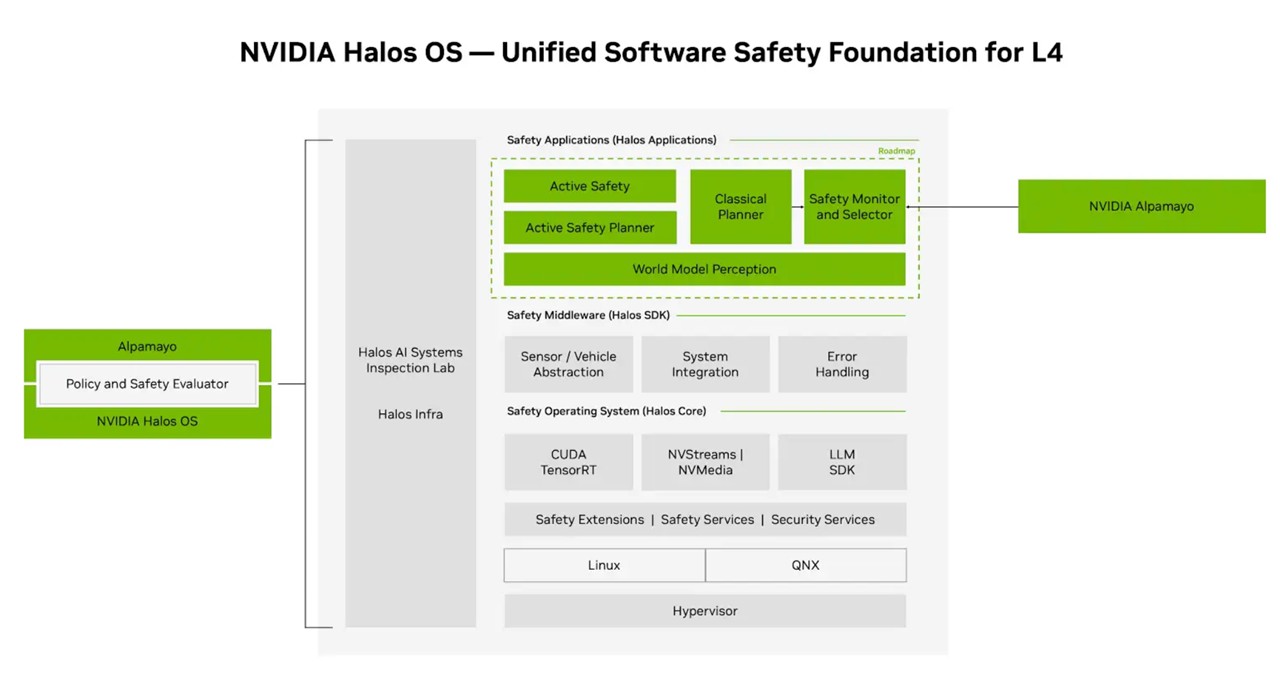
The newly introduced Halos Operating System (OS) from NVIDIA provides a solid production-ready safety foundation for AI-driven vehicles using NVIDIA DRIVE Hyperion. This system is geared towards surmounting the challenges mentioned above.
Halos Core: A Certified OS Foundation
At the core of the NVIDIA Halos OS is Halos Core, the next iteration of NVIDIA DriveOS, which complies with automotive safety standards. This component has been rigorously audited and documented to ensure predictable performance under various fault conditions. A specialized software layer, known as a hypervisor, helps to isolate crucial safety functions, ensuring that any failures remain contained and do not compromise vehicle control.
Halos Core adheres to ISO 26262 ASIL D, along with incorporating safety-certified support for NVIDIA’s CUDA and TensorRT, which is vital for achieving high-performance inference in real-time applications.
Halos SDK: Standardized and Safe Interfaces
Robotaxis incorporate an array of sensors, such as cameras and Lidar, each producing data in unique formats and rates. The absence of a standardized middleware could lead to a cumbersome integration process every time there’s a hardware modification. However, the Halos SDK alleviates this issue through its sensor abstraction layer, enabling the autonomous driving technology to operate independently from specific sensor drivers.
This modular approach ensures that adding or replacing a sensor doesn’t necessitate major adjustments in the application code. Furthermore, the vehicle abstraction layer connects the driving stack to the rest of the vehicle via a consistent interface, fostering easier integration and operational reliability.
Halos Applications: Safety Guardrails for AI
While AI models can mimic human driving behaviors quite effectively, regulatory requirements demand more than just performance. The Halos Applications layer introduces definitive safety guardrails by employing deterministic, rule-based functions designed to operate within strictly defined parameters. Key features include advanced world model perception and the highly regarded NVIDIA DRIVE active safety stack, which incorporates functionalities like automatic emergency braking, lane departure warning, and blind spot monitoring.
Additionally, Halos Applications effectively synergize with end-to-end AI models where explainability and transparency are critical. This integration includes the NVIDIA Alpamayo family of open models for autonomous development, facilitating continuous evaluation of the environment and optimally planning next maneuvers as conditions change.
The Halos Safety Evaluation Framework
Designed to enhance the scalability of training and simulation for autonomous vehicles, Halos Infra serves as the foundational infrastructure for NVIDIA’s extensive safety evaluation framework.
The NVIDIA Halos Safety Evaluation Framework (SEF) offers essential tools and guidelines that aid in constructing a credible safety case, covering everything from L2 driver assistance systems to fully autonomous L4 robotaxis. Insights from over 330 research papers and 1,000 patents that have emerged from the NVIDIA Halos OS underscore its depth and utility.
Halos Infra operates on NVIDIA’s cutting-edge three-computer autonomous driving architecture, ensuring that the Halos OS encompasses the entire development lifecycle—from training and simulation within Halos Infra to real-time inference in vehicles.
Learn more about NVIDIA Halos.
Inspired by: Source


