


Introduction to Cloudflare’s Model Context Protocol (MCP)
Cloudflare is making waves with its introduction of the Model Context Protocol (MCP), a transformative method that revolutionizes how AI agents access complex APIs. Powered by Code Mode, this new server significantly reduces the costs associated with interacting with Cloudflare’s comprehensive API platform. This innovative approach paves the way for agent-to-tool integrations within the MCP ecosystem, allowing for more efficient workflows.
- Introduction to Cloudflare’s Model Context Protocol (MCP)
- Understanding the Model Context Protocol (MCP)
- The Innovation of Code Mode
- Remarkable Token Efficiency
- Searching and Executing with Ease
- Security and Execution Safeguards
- Integration and Availability for Developers
- Broad Implications for AI Developments
Understanding the Model Context Protocol (MCP)
At its heart, the MCP serves as an emerging standard designed for large language models (LLMs) to seamlessly connect with external tools and APIs. It exposes structured tools that the models can call during their execution, which enhances their functionality. Traditionally, developers faced a dilemma; every API endpoint represented a separate tool definition, consuming valuable tokens from the model’s limited input budget. This inefficiency often constrained the reasoning capabilities of the AI, impacting its performance on user tasks.
According to Luuk Hofman, a solutions engineer at Cloudflare, the team sought a more efficient solution:
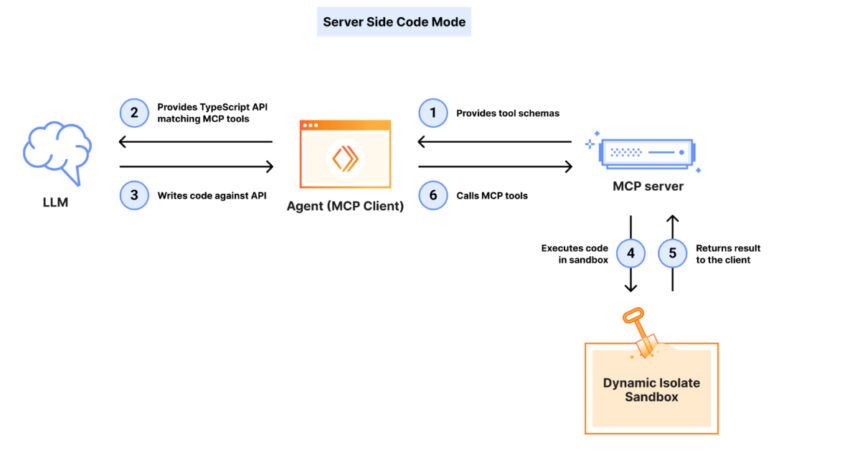
“So we tried: convert MCP tools into a TypeScript API and just ask the LLM to write code against it.”
The Innovation of Code Mode
Cloudflare’s solution, Code Mode, simplifies this challenge by limiting the number of exposed tools to just two:
search()for querying the OpenAPI specificationexecute()for running JavaScript inside a secure V8 isolate.
This architecture allows agents to compile their complex plans into a compact code snippet that orchestrates multiple operations against the OpenAPI specification. As a result, developers can avoid the repetitive token costs associated with loading endpoint definitions into the model’s context.
More Read

Remarkable Token Efficiency
One of the standout features of Code Mode is its dramatic reduction in token consumption. Cloudflare reports that users can interact with over 2,500 API endpoints using just about 1,000 tokens, a staggering reduction from the previous requirement of more than 1.17 million tokens. This remarkable efficiency allows agents to function effectively across large, feature-rich platforms without consuming an overwhelming amount of context.
In a Reddit post, Cloudflare emphasized the impact of their specialized encoding strategy:
“The team utilized a specialized encoding strategy to fit expansive API schemas into minimal context windows without losing functional precision.”
Searching and Executing with Ease
With search(), agents can effectively query the OpenAPI specification based on specific criteria such as product area, path, or metadata. Crucially, the specification itself never enters the model’s context, simplifying the data handling process. The execute() function is equally powerful, managing pagination, conditional logic, and chaining API calls in a streamlined cycle. This capability cuts down on costly round-trip overhead, greatly enhancing execution efficiency.
Security and Execution Safeguards
Security is paramount when dealing with user-generated code. Cloudflare has taken meticulous precautions by running all user-generated code within a Dynamic Worker isolate, ensuring a secure runtime environment. It deliberately restricts file system access and limits outbound requests through explicit handlers, significantly reducing the risks associated with executing untrusted code while maintaining agent autonomy.
Integration and Availability for Developers
The new MCP server is not just a theoretical improvement; it has already integrated services across DNS, Zero Trust, Workers, and R2 services, making it readily available for developers. Furthermore, Cloudflare has taken an open-source approach by releasing the Code Mode SDK within its broader Agents SDK. This helps to foster similar operational patterns in third-party MCP implementations, reinforcing the ecosystem.
Broad Implications for AI Developments
Experts and practitioners in the industry are excited about the potential of Code Mode as a pivotal advancement in scaling agentic workflows. It moves beyond simple, single-service interactions to unlock the possibilities of extensive multi-API automation. This innovative pattern could serve as a guiding framework for future MCP server designs and agent architectures in the evolving AI landscape, as industry leaders continue to tackle issues related to context costs and orchestration complexities.
Inspired by: Source


