


Building the Future of AI: Meta and Hugging Face’s OpenEnv Hub
The rapid growth of artificial intelligence (AI) is transforming industries, creating new possibilities for automation and intelligent systems. With tools like TRL, TorchForge, and VeRL, the open-source community has pioneered methods to scale AI across complex compute infrastructures. However, compute resources are just one aspect of this advancement; the true magic lies within the developer community. Recognizing this, Meta and Hugging Face have teamed up to launch the OpenEnv Hub, an innovative platform aimed at fostering collaboration and creativity in agentic environments.
The Need for Agentic Environments
Agentic environments are essential for executing tasks autonomously through AI agents. While large language models (LLMs) are powerful, they need a structured setup to operate, making agentic environments indispensable. These environments are designed to define everything an agent requires to perform its tasks—tools, APIs, credentials, context, and more—without the clutter of unnecessary elements. They ensure clarity, safety, and sandboxed control, essential for reliable agent behavior.
Challenges with Current AI Approaches
Modern AI agents can take action across numerous tasks, but merely providing access to a vast array of tools poses challenges regarding safety and practicality. It’s unfeasible (and risky) to expose millions of tools directly to a model. Instead, agentic environments serve as safe, semantically clear sandboxes that deliver:
- Clear semantics detailing task requirements
- Sandboxed execution with safety protocols
- Seamless access to authorized tools and APIs
Introducing the OpenEnv Hub
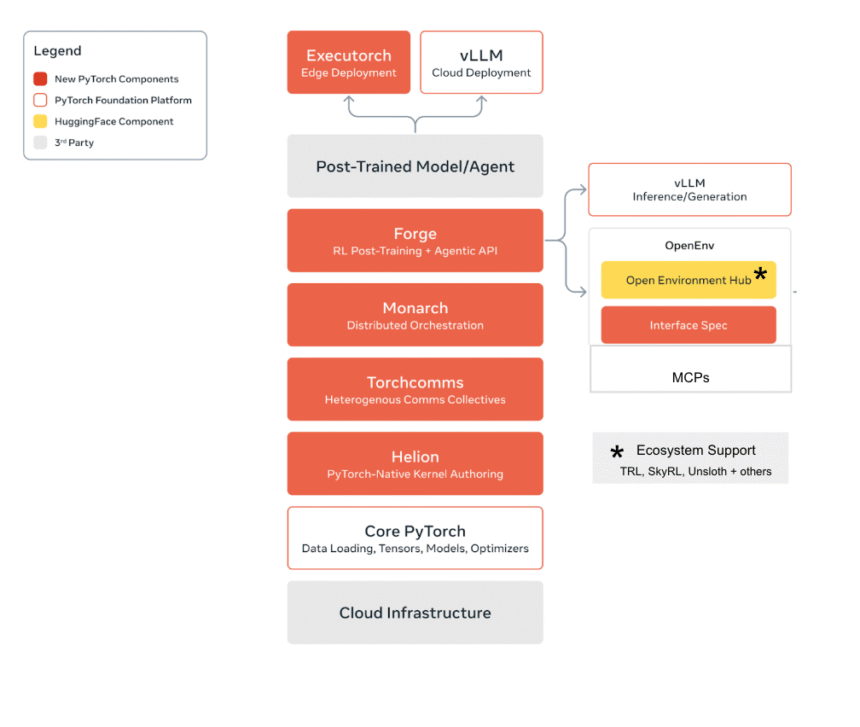
To seamlessly empower the next wave of agentic development, Meta-PyTorch and Hugging Face’s OpenEnv Hub is a shared space for developers to build, share, and explore OpenEnv-compatible environments. This initiative allows for both training and deployment, with significant integrations with libraries like TRL, SkyRL, and Unsloth in motion. The visual representation below illustrates how OpenEnv fits into the evolving AI ecosystem:
Getting Started with the Hub
Next week, developers are invited to explore the new Environment Hub on Hugging Face, which initially features a range of environments. Here’s what you can do:
- Engage with environments as a Human Agent
- Utilize models to tackle tasks within the environment
- Examine which tools are available and how they are defined
- Automatically gain functionality for environments uploaded that conform to the OpenEnv specification, enabling rapid validation and iteration before conducting full reinforcement learning (RL) training
The RFCs Drive Standardization
The OpenEnv initiative is grounded in community feedback, with the release of the OpenEnv 0.1 Spec (RFC) aimed at shaping future standards. In the current state, environment creators can build environments using APIs like step(), reset(), and close(). Local Docker-based environments can also be trialed. Under review are several RFCs, each addressing critical components:
- RFC 001: Defining the relationship between core elements such as Environment, Agent, and Task
- RFC 002: Proposing a basic environment interface and communication standards
- RFC 003: Encapsulating tools through the abstraction of environments
- RFC 004: Extending support for unified action schemas covering various agent utilities
Potential Use Cases
The applications of agentic environments are vast:
- RL Post Training: Utilize collections of environments to train RL agents with tools like TRL and TorchForge+Monarch.
- Environment Creation: Develop environments that interoperate with popular RL tools, fostering collaboration.
- Reproduction of SOTA Methods: Easily replicate state-of-the-art methods, such as those from FAIR’s Code World Model.
- Deployment: Create and train environments for both training and inference, ensuring a cohesive development pipeline.
Looking Ahead
This is merely the beginning for the OpenEnv Hub. Ongoing integration with Meta’s innovative TorchForge RL library and collaboration with other open-source projects like verl, TRL, and SkyRL promise to broaden compatibility and functionality. Interested developers should join us at the PyTorch Conference on October 23 for a live demonstration and walkthrough of the specifications. Moreover, don’t miss our upcoming community meetup focusing on environments, RL post-training, and enhancing agentic development.
👉 Dive into the OpenEnv Hub on Hugging Face and start constructing the environments that will power the next generation of AI agents!
👉 Check out the 0.1 specification implemented in the OpenEnv project, and contribute your ideas for improvement!
👉 Engage with the community on Discord to discuss topics surrounding RL, environments, and agentic development.
👉 Try out our comprehensive notebook that guides you through an end-to-end example, easily installable via pip from PyPI, or test it in Google Colab!
👉 Explore supporting platforms such as Unsloth, TRL, and Lightning.AI, as we work together to construct the future of open agents!
Inspired by: Source


