


Innovative Radiative Cooling Techniques: A Breakthrough for Energy Savings
Modern architects and engineers are pushing the boundaries of how we think about temperature control in buildings. From California’s supermarket rooftops to Japan’s Expo 2025 pavilion, innovative cooling solutions are redefining our approach to energy efficiency. A standout advancement comes from a breakthrough in radiative cooling, which allows surfaces to dissipate heat even under full sunlight, a concept that seemed impossible until recent years.
The Science Behind Radiative Cooling
Traditionally, surfaces exposed to sunlight couldn’t cool below the ambient temperature due to the influx of heat. However, in 2014, a team led by researcher Shanhui Raman developed a new class of photonic films specifically designed to absorb and dissipate heat at infrared wavelengths between eight and 13 micrometers. This spectral range falls within what’s known as the “atmospheric window,” which allows heat to escape into space. These films demonstrated their effectiveness by cooling building interiors to a remarkable 9°F below ambient temperatures without any energy input or air conditioning.
Shifting Focus: From Advanced Photonics to Simplified Materials
While the initial findings were groundbreaking, the industry has since moved towards more practical alternatives to advanced photonics. Today, simpler materials—such as ceramic cool roofs, nanostructured coatings, and reflective polymers—are gaining traction. These materials not only reflect more sunlight across various wavelengths but also boast enhanced durability and scalability, making them suitable for widespread application.
The Race for Efficiency: Startups Leading the Charge
A growing number of startups are fiercely competing in the market to manufacture coatings that maximize sunlight reflection. Companies like SkyCool, Planck Energies, Spacecool, and i2Cool are at the forefront of this battle, aiming to create coatings that reflect at least 94% of sunlight in most climates, and achieve over 97% in humid, tropical areas. Early pilot projects have shown significant promise, reporting reductions in air conditioning needs by 15% to 20% for residential buildings. The potential for energy savings is massive, transforming how we think about indoor comfort.
Expanding Applications: Beyond Buildings to Personal Wear
The potential of reflective materials goes well beyond rooftops and roads. Researchers are now delving into the development of reflective textiles that can provide personal thermal management for individuals most vulnerable to heat exposure, such as outdoor workers and athletes. “This is personal thermal management,” notes researcher Gan. Imagine T-shirts and sportswear fitted with these advanced fabrics that keep wearers cool even in sweltering conditions—this could revolutionize outdoor activity and work conditions in hotter climates.
More Read

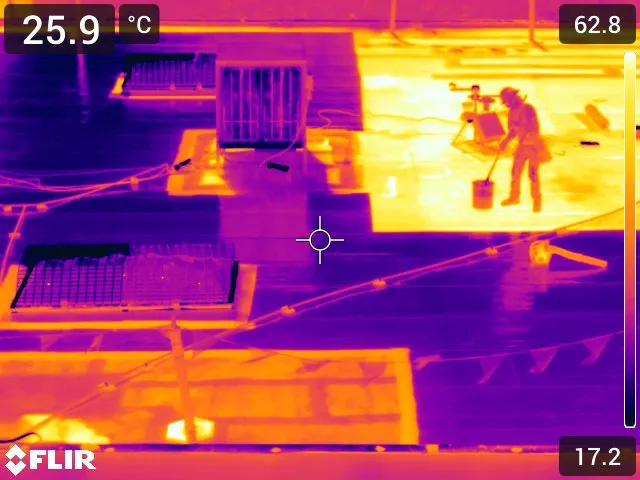
Image Caption: A thermal image captured during a SkyCool installation shows treated areas (white, yellow) that are roughly 35 ºC cooler than the surrounding rooftop. COURTESY OF SKYCOOL SYSTEMS
Addressing Limitations and Environmental Concerns
Despite these advancements, challenges remain. Many cooling technologies, similar to solar panels, are susceptible to environmental conditions. Cloud cover can diminish their effectiveness, while dust and pollution can degrade their reflective capabilities over time. Furthermore, some of the most effective materials currently available utilize Teflon and other fluoropolymers—known as "forever chemicals"—which pose long-term environmental risks.
Raman highlights, “They are the best class of products that tend to survive outdoors.” However, the question remains: can we scale these solutions without relying on materials that have adverse environmental impacts? The search for sustainable alternatives is ongoing, emphasizing the need for research into materials that offer durability without compromising ecological safety.
A Balanced Approach to Cooling Solutions
Despite the promise of radiative cooling technologies, experts caution against viewing them as an ultimate solution. As Gan points out, we must avoid overoptimism: “We cannot be overoptimistic and say that radiative cooling can address all our future needs.” Traditional air conditioning systems still play a vital role, especially in areas experiencing extreme heat. A shiny roof isn’t a cure-all; however, it is undeniably a step in the right direction.
This innovative approach to cooling could be a game-changer for energy savings and environmental impact, representing a fascinating shift in how we manage heat in our built environment. The race continues, with countless opportunities for research and development to create a more sustainable and comfortable future for all.
Inspired by: Source


