


Automation Revolution: Grab’s Multi-Agent AI System Transforming Engineering Support
Grab, a giant in Southeast Asia’s ride-hailing and food delivery sectors, is leveraging cutting-edge technology to optimize its analytics support operations. The Analytics Data Warehouse (ADW) team has initiated a transformative multi-agent AI system aimed at automating engineering support workflows. This innovative approach seeks to minimize repetitive tasks and enhance the efficiency of resolution processes within Grab’s expansive data infrastructure.
The Challenge: Operational Bottlenecks in a Growing Platform
With over 1,000 internal users and upwards of 15,000 tables, the ADW platform stands as a cornerstone of Grab’s analytics ecosystem. However, as user demand surged, the engineering team noted that a considerable amount of their time was absorbed by mundane support tasks and ad hoc investigations. This operational burden significantly restricted their ability to focus on meaningful platform enhancements and essential system design projects.
Sneh Agrawal, Head of Analytics at Grab, shared insights in a LinkedIn post about the necessity of this shift:
“Grab’s Central Data Team is leveraging a multi-agent system to automate repetitive operational work, reclaiming hundreds of engineering hours each month. This shift is unlocking critical engineering bandwidth and enabling a transition from reactive firefighting to higher-value system building.”
Multi-Agent Architecture: A Two-Pronged Approach
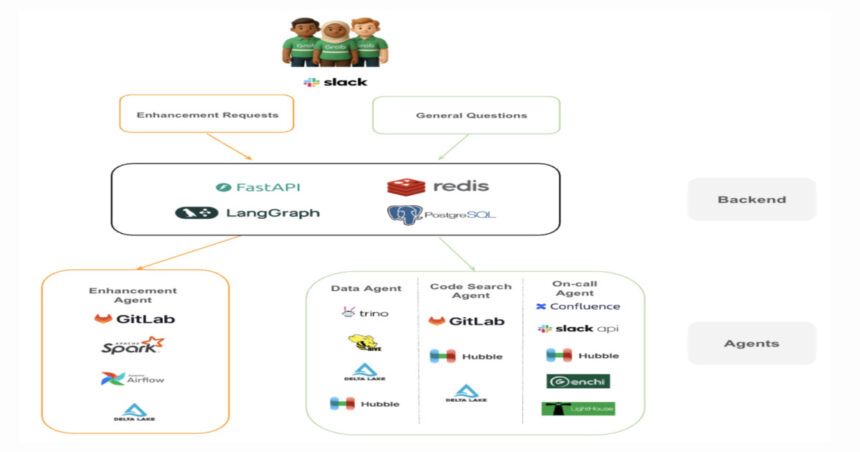
To combat the challenges posed by redundant tasks, Grab’s engineering team devised a multi-agent architecture that segregates incoming requests into two primary workflows: investigation and enhancement.
-
Investigation Workflows: These workflows are tailored for diagnostic functions such as query analysis, log retrieval, schema lookup, and summarizing issues.
-
Enhancement Workflows: Focused on generating actionable outcomes, these workflows encompass code changes, SQL fixes, and automated merge requests aimed at review processes.
Workflow Engine and Agent Coordination
The orchestration of this complex system employs a LangGraph-based workflow engine integrated with FastAPI services. This powerful combination facilitates task routing, tool execution, and effective state management among the various agents. Initially, incoming requests are classified, after which they are routed to specialized agents designed to undertake tasks like context retrieval, code searching, or solutions generation. Each agent operates within specific boundaries, thus reducing ambiguity and enhancing output predictability.
Simplifying the Tool Ecosystem
One of the pivotal architectural decisions was consolidating the tool ecosystem, which was originally cumbersome with over 30 internal tools. This consolidation resulted in a more manageable and curated toolset, making the system easier to maintain and less prone to unpredictable tool selection by agents. The streamlined tool layer comprises controlled SQL execution, efficient metadata access, log retrieval systems, and seamless integration with Git-based workflows to simplify change management.
Ensuring Safety and Governance
Incorporating safety and governance into the system’s core design was paramount. SQL execution is moderated through validation layers to prevent misuse, while the handling of sensitive data includes proactive risk detection and mitigation strategies. Notably, all enhancements producing code changes require human oversight before deployment, safeguarding the automated outputs from bypassing critical engineering review.
Tackling Context Management Challenges
A significant technical hurdle faced by the engineering team was context management. Maintaining relevant state across multi-step interactions while adhering to token constraints was crucial for agent performance. The solution lay in implementing structured context compression and selective retrieval approaches, enabling agents to retain pertinent information without exceeding operational limits.
Transformative Outcomes: A Shift in Focus
The introduction of the multi-agent AI system has led to a marked reduction in the time spent on routine engineering support tasks. Engineering teams reported faster resolution cycles for common issues, alleviating much of the operational strain they previously experienced. While specific performance metrics are yet to be disclosed, the qualitative feedback underscores a positive pivot—from managing crises to focusing on meaningful platform engineering and continuous system improvement.
The Future of Engineering Support at Grab
As Grab continues to evolve and expand its offerings, the implementation of such transformative technologies shall serve as a blueprint for other organizations looking to streamline their operational workflows. With the pressures of rapid growth alleviated through automation, Grab can dedicate more resources to innovate and enhance its services, ultimately improving the experience for both users and engineers alike.
By harnessing the power of AI-driven support systems, Grab is setting new benchmarks in operational efficiency within the analytics domain, showcasing the potential for technology to redefine traditional engineering practices.
Inspired by: Source


