


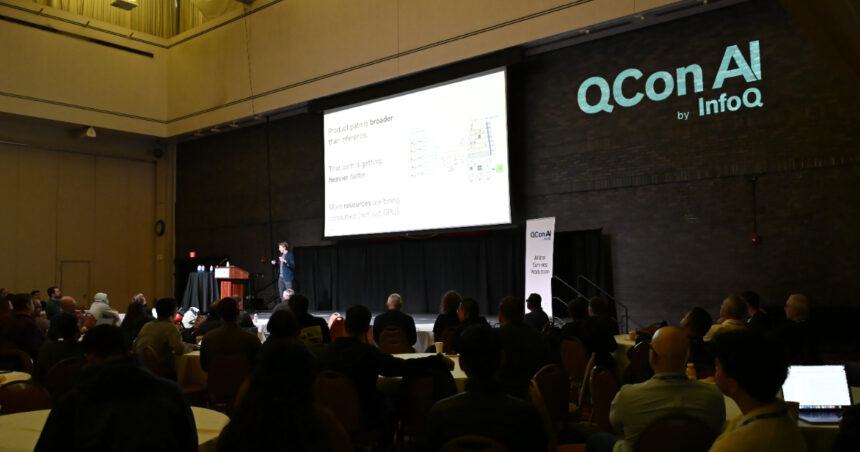
QCon AI Boston 2026: Redefining the Future of AI Infrastructure
QCon AI Boston 2026 was a landmark event that highlighted the evolution of artificial intelligence (AI) as we transition from simply creating AI agents to effectively managing them in a production environment. The theme of the conference revolved around building reliable infrastructure capable of supporting AI agents, a notion reinforced by numerous speakers.
Opening Keynote Highlights
OpenAI’s Martin Spier kicked off the conference with a compelling keynote address centered on performance—though not just in terms of making inference faster. Spier emphasized the need for adequate context before the model generates a response. This “quiet stretch” involves refining the conversation to make it usable, clearly indicating that the work required to ensure a fast product extends far beyond any improvements to the model itself.
“The basics became more important.” — Martin Spier
This insightful observation set the tone for the days to follow, where the focus shifted from flashy AI capabilities to the essential infrastructure that determines whether an AI system can effectively engage with real users.
Context and Infrastructure: The New Paradigm
One of the prominent themes that emerged was the rising importance of context and agent infrastructure, which are evolving into a dedicated platform layer. Organizations are gradually moving away from single-purpose applications and toward shared systems that encompass context management, tool access, identity, and state management.
As teams prioritize cohesive systems, foundational concepts like context engineering and semantic catalogs are being recognized as core components of infrastructure. With this shift, the responsibility for these elements necessitates specific ownership and accountability, setting up a framework for sustainable AI deployment.
More Read

“Context engineering isn’t a feature; it’s architecture. Get this right and everything else gets easier.” — Ricardo Ferreira
Trust and Security in AI Systems
A significant takeaway from QCon AI Boston was the increasing focus on trust within AI systems. This entails a move away from merely having prompt-level safeguards to fostering trustworthy execution through a comprehensive harness around AI agents.
As these agents gain access to various tools and data, relying on prompt instructions for security is no longer viable. A robust harness system will enable clear ownership of state, ordered data modifications, and an auditable trail of actions taken by the AI. The conversation has shifted from whether an agent provides a correct answer to efforts aimed at proving the actions undertaken within the system.
“Own the state. Order the mutation. Prove the action.” — Vinoth Govindarajan
Adoption as an Engineering Operating Model
The event highlighted that AI adoption is maturing into an engineering operating model. As organizations begin to deploy AI more extensively, new questions arise regarding the management and operation of these agents. Who finances usage, which tools are accessible, and how are failures documented?
Merely exposing your AI model through an API or providing engineers with a chatbot isn’t sufficient any longer. Organizations now require structured pathways, policy surfaces, evaluation loops, observability, and mechanisms for cost attribution that guide behavior toward long-term, effective strategies rather than quick fixes.
“The most effective organizations do two things: thoroughly improve AI usage across the SDLC and resolve the bottlenecks that limit outcomes.” — Lizzie Matusov
Evaluation: Beyond Traditional Testing
A standout topic at the conference was the discussion on re-evaluating benchmarks and testing methodologies. Traditional one-shot tests may fail to capture the multi-turn nature of conversations that AI agents often engage in. The interaction dynamics of these systems can lead to nuanced failures that aren’t typically detected by static benchmarks.
To overcome this, testing methodologies must evolve to better mirror the operational context of AI systems. Evaluations should focus on conversations, traces, simulations, and real-world feedback to capture the complexity and variability of user interactions.
Closing Thoughts on Future Directions
The overall sentiment at QCon AI Boston 2026 emphasized that the future of production AI companies is shifting focus from prompt engineering to broader systemic challenges. The hard problems now dwell within context management, data contracts, agent security, and observability.
As AI systems increasingly resemble human collaborators, they also share the vulnerabilities associated with software engineering. Thus, effective management of these agents draws on established lessons from platform engineering and distributed systems, paving the way for more reliable and trustworthy AI deployments.
The dynamic discussion at the conference illuminated a clear path for organizations aiming to integrate AI solutions into their workflows effectively, marking a significant milestone in the evolution of AI infrastructure.
Inspired by: Source


