


Lightelligence’s Game-Changing IPO: What Investors See Beyond the Numbers
When a company with annual revenue of US$15.5 million makes its debut on a stock exchange and briefly peaks in market capitalization at US$10 billion, investors are left asking: what are they seeing that the financial metrics don’t fully reveal? In the case of Lightelligence, a significant focus is placed on optical interconnect technology, a revolutionary approach poised to address the limitations of conventional copper wiring, particularly in the realm of artificial intelligence.
The Surge of Lightelligence
Lightelligence made headlines recently as it became the first mainland Chinese photonics chipmaker to go public in Hong Kong. Its trading debut was nothing short of spectacular, with stock prices soaring nearly 400%. The company opened trading at HK$880, substantially higher than its initial offer price of HK$183.2, raising HK$2.4 billion (around US$310 million) in its IPO. Remarkably, the retail tranche was oversubscribed an incredible 5,785 times, highlighting strong investor interest and belief in the company’s future potential.
Understanding Optical Interconnect Technology
To grasp the enthusiasm surrounding Lightelligence, it’s essential to comprehend the problems the company is aiming to solve. As modern AI models become increasingly complex — powering technologies like large language models and image generation tools — the need for efficient data transfer among vast clusters of chips becomes critical. Traditionally, this data travels through copper electrical connections. However, as AI clusters expand in size and energy demands, copper wiring can create significant bottlenecks. Issues such as heat generation, high power consumption, and limited data transmission capabilities hinder performance.
Optical interconnect technology addresses these concerns by replacing electrical signals with light. This shift offers lower latency, higher bandwidth, and improved energy efficiency. Imagine moving from a single-lane road to a multi-lane motorway: more information travels faster and with less congestion.
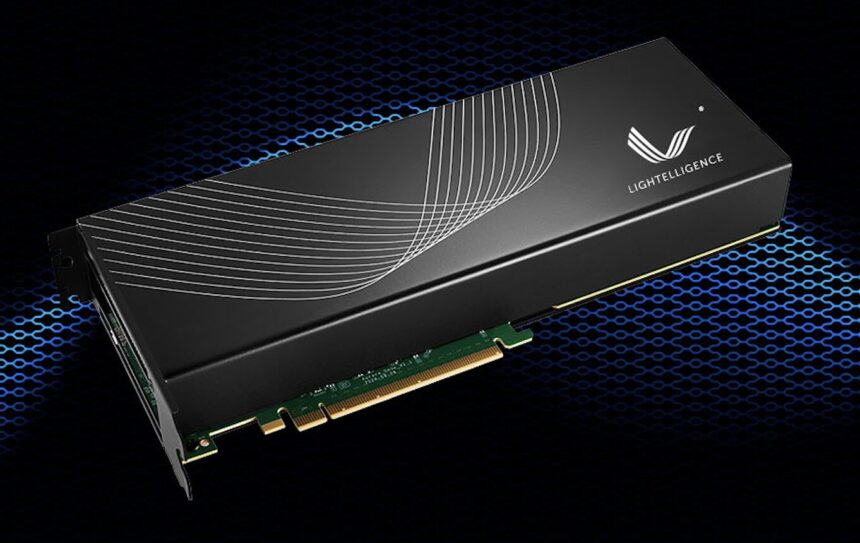
Lightelligence specializes in two primary segments: optical interconnect, which links computing devices within a single server or across clusters, and optical computing, where data processing utilizes photons rather than electrons. Their flagship product, LightSphere X, is described as the first distributed optical circuit-switching solution for GPU supernode interconnects. The company claims it can boost model FLOPS utilization by over 50%, effectively lowering the total cost of ownership for computing tasks.
More Read

Lightelligence’s Market Positioning
According to Frost & Sullivan research, Lightelligence stands out as the first company to achieve commercial-scale deployment of optoelectronic hybrid computing. This distinction is vital in a market still largely filled with research entities and nascent startups. As of early 2026, Lightelligence boasts 410 patents, more than half applicable to both optical interconnect and optical computing technologies.
In China’s burgeoning optical interconnect sector, Lightelligence has claimed the top spot among independent providers by revenue, capturing 88.3% of the market share in the segment that connects chips within high-performance computing nodes. However, it’s essential to note that Huawei dominates the overall market with a 98.4% share, relegating Lightelligence to the position of the largest third-party supplier.
By late 2025, Lightelligence had established partnerships with 44 commercial customers, supporting GPU clusters comprising thousands of cards. Their impressive investor lineup for the IPO includes heavyweights like Alibaba, GIC, Temasek, BlackRock, Fidelity International, Schroders, Hillhouse Capital, Lenovo, and ZTE, indicative of robust confidence in its growth trajectory.
Analyzing the Financial Landscape
The financial landscape of Lightelligence paints a more nuanced picture. Despite reporting revenues of RMB 38 million (approximately US$5.6 million) in 2023, and RMB 106 million (about US$15.5 million) in 2025, the company is not without its challenges. Rapid revenue growth is accompanied by a troubling increase in losses, which widened to RMB 1.34 billion in 2025. Their asset-liability ratio stands alarmingly at 473%, indicating that liabilities far surpass assets—a critical risk factor for potential investors.
Moreover, a single customer represents 40.6% of their revenue, introducing an element of concentration risk that any savvy investor would undoubtedly note.
The Influence of Leadership
Much of the company’s premium valuation can be attributed to its founder, Yichen Shen, who gained prominence for publishing a groundbreaking paper in Nature Photonics in 2017. His work, which explored the feasibility of using light in deep learning computations, is viewed as a seminal contribution to the field of optoelectronic hybrid computing. The company he founded is now well-positioned to leverage that research in its public market journey.
Growth Prospects in the AI Market
The global AI computing and interconnect market is projected to grow at a 27% compound annual rate through 2031, as per Frost & Sullivan. This creates an intriguing landscape and raises essential questions: Can Lightelligence scale its revenue to match this growth trajectory? Will it be able to align its losses with its ambitious plans? These are the calculated risks that investors are wagering a US$10 billion premium to validate.
As Lightelligence continues its journey post-IPO, the market will be watching closely to see if the projections align with reality. The debut certainly sets the stage for what could be a transformative period in the tech landscape, particularly for optical interconnect technology.
For those eager to explore more about the burgeoning fields of AI and big data, consider attending the AI & Big Data Expo, featuring insights from industry leaders in Amsterdam, California, and London. Discover what the future holds by engaging with the community at these exciting technology events!
Inspired by: Source


