


Uncertainty in Machine Learning: Probability & Noise
Image by Author
Editor’s note: This article is a part of our series on visualizing the foundations of machine learning.
Welcome to the latest entry in our series on visualizing the foundations of machine learning. In this series, we will aim to break down important and often complex technical concepts into intuitive, visual guides to help you master the core principles of the field. This entry focuses on the uncertainty, probability, and noise in machine learning.
Uncertainty in Machine Learning
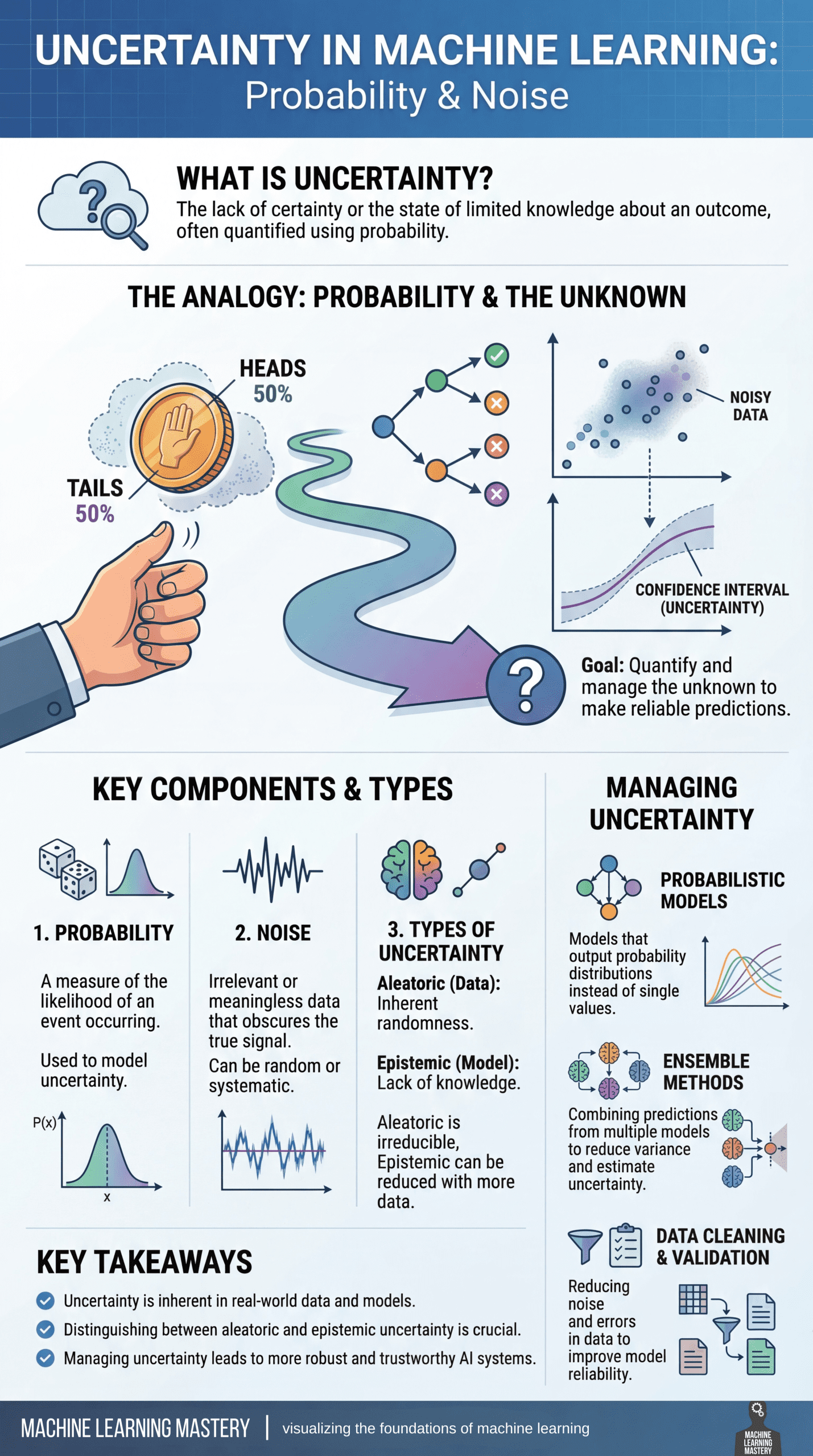
Uncertainty is an intrinsic aspect of machine learning that permeates every stage of the modeling process. It arises when models attempt to predict future outcomes based on historical data and is essentially a reflection of incomplete knowledge about the environment being modeled. Reframing uncertainty as a necessary consideration rather than a flaw allows practitioners to enhance the credibility and reliability of their predictive models.
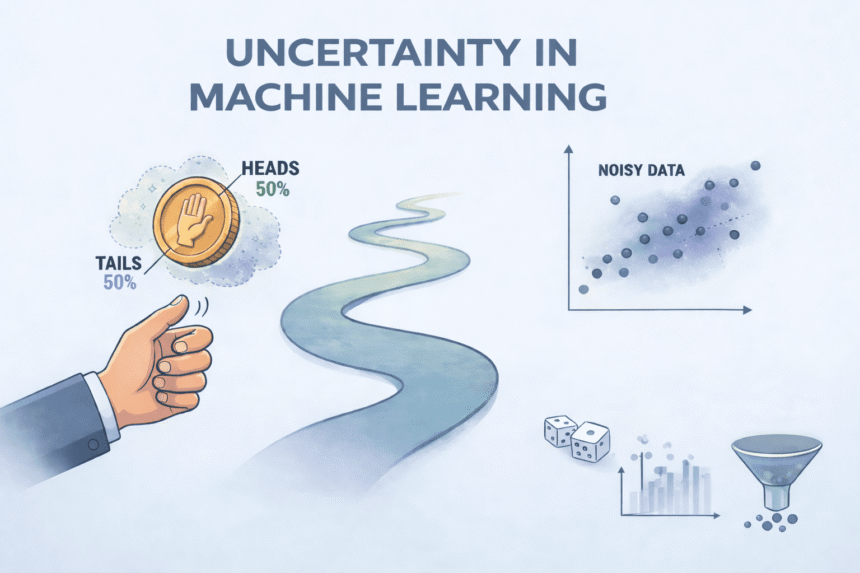
To grasp the concept of uncertainty, consider the act of flipping a fair coin. While the probabilities for heads or tails are well defined, individual outcomes remain uncertain. This analogy mirrors the conditions under which machine learning systems often operate, where multiple potential outcomes stem from variations in data and inherent randomness. As data flows through a model, these probabilistic pathways form, influenced by factors like incomplete information and noise in the data.
Understanding Key Components of Uncertainty
The journey of managing uncertainty involves understanding its two principal components: probability and noise. Probability serves as the mathematical backbone, providing a framework for estimating the likelihood of various outcomes. On the other hand, noise introduces variability within the data that obscures the accurate signal we wish to capture, manifesting as either random deviations or structured biases.
These elements together contribute significantly to the uncertainty that exists within model predictions. It’s crucial to differentiate between the types of uncertainty encountered in machine learning:
- Aleatoric uncertainty is born from inherent randomness in the data itself. It signifies limitations in predictability that cannot be diminished even when new information is introduced.
- Epistemic uncertainty emerges from gaps in our understanding of the model or the processes generating the data. This type of uncertainty can often be reduced by gathering more information or enhancing model design.
Recognizing and distinguishing between these types is essential for interpreting model behavior effectively. This understanding facilitates targeted strategies to mitigate uncertainty and improve predictive performance.
Strategizing Uncertainty Management
Machine learning practitioners employ a variety of strategies to manage uncertainty effectively. One prominent approach is to utilize probabilistic models, which generate full probability distributions. Whereas traditional models might yield only single-point predictions, probabilistic models make uncertainty explicit, allowing for more transparent decision-making processes.
Another effective strategy is the use of ensemble methods. By combining the outputs of multiple models, ensemble techniques minimize variance and refine uncertainty estimation, providing a more robust prediction framework.
Cleaning and validating data is also paramount. This practice not only enhances the integrity of the dataset but also mitigates noise that can compromise the model’s reliability. Systems can be fortified further through techniques such as outlier detection, feature selection, and validation checks, ensuring that the training data is both comprehensive and representative.
Ultimately, recognizing uncertainty as a fundamental aspect of real-world data and machine learning systems allows for more informed modeling and decision-making. By embedding uncertainty management strategies into the workflow, practitioners can create models that are more accurate, robust, transparent, and trustworthy.
Uncertainty, Probability & Noise: Visualizing the Foundations of Machine Learning (click to enlarge)
Image by Author
Machine Learning Mastery Resources
For those looking to expand their understanding of probability and noise in machine learning, consider exploring the following resources:
- A Gentle Introduction to Uncertainty in Machine Learning – This article elucidates what uncertainty entails and examines principal causes such as data noise, coverage gaps, and model imperfections. It also demonstrates how probability equips practitioners with the tools to quantify and navigate uncertainty.
Key takeaway: Probability is essential for understanding and managing uncertainty effectively in predictive modeling. - Probability for Machine Learning (7-Day Mini-Course) – A structured crash course that guides participants through fundamental probability concepts applicable in machine learning. It covers everything from types of probability and distributions to practical applications in Python.
Key takeaway: Building a solid foundation in probability enhances your ability to apply and interpret machine learning models successfully. - Understanding Probability Distributions for Machine Learning with Python – This tutorial covers important probability distributions integral to machine learning tasks, illustrating their applications and providing Python examples for clarity.
Key takeaway: Mastery of probability distributions is vital for effectively modeling uncertainty throughout the machine learning process.
Stay tuned for upcoming entries in our series on visualizing the foundational concepts of machine learning.
Inspired by: Source


