


In the realm of computational biology, groundbreaking projects often start from unexpected places. Tanya Berger-Wolf, the director of the Translational Data Analytics Institute and a professor at The Ohio State University, found herself at the forefront of innovation with her first project—a friendly challenge with a colleague. The wager? She believed she could develop an AI model to identify zebras more quickly than a trained zoologist. Spoiler alert: She won.
Fast forward to today, Berger-Wolf has expanded her vision to encompass the entire animal kingdom with her latest creation, BioCLIP 2. This biology-based foundation model is trained on the most extensive and diverse dataset of organisms ever compiled, and it’s set to make waves at the upcoming NeurIPS AI research conference.
BioCLIP 2 is not just a simple algorithm for recognizing images; it transcends traditional analysis by being able to discern species traits and interspecies relationships. A fascinating example lies in its ability to categorize Darwin’s finches based on beak size. What makes this extraordinary is that it achieved this without prior instruction on the concept of “size,” illustrating its advanced learning capabilities.
This innovative model serves not merely as a biological encyclopedia but as a powerful scientific platform and an interactive research tool. One of its critical features is addressing data deficiency issues in conservation biology. For species like killer whales and polar bears, substantial gaps in population data are evident. “If we don’t have data for those species, what hope do the beetles and fungi have?” Berger-Wolf points out. AI models like BioCLIP 2 can enhance existing conservation efforts by filling these crucial gaps.
Available under an open-source license on Hugging Face, BioCLIP 2 received considerable attention, with over 45,000 downloads last month alone. This model builds on the success of the first BioCLIP model, which was released just over a year ago and won the Best Student Paper award at the Computer Vision and Pattern Recognition (CVPR) conference.
Building the World’s Largest Biological Flash Card Deck
The creation of BioCLIP 2 began with a colossal dataset named TREEOFLIFE-200M, consisting of 214 million images across more than 925,000 taxonomic classes—ranging from monkeys to mealworms and magnolias. To curate this treasure trove of information, Berger-Wolf collaborated with the Smithsonian Institution, experts from various universities, and other field-related organizations.
The intention? To investigate how training a biological model on unprecedented amounts of data could push the boundaries of our understanding, moving from the study of individual species toward the science of entire ecosystems. After a mere ten days of training on a stellar array of 32 NVIDIA H100 GPUs, BioCLIP 2 revealed remarkable abilities, such as differentiating between adult and juvenile members within species, and even distinguishing male from female, all without being explicitly taught.
Moreover, the model can discern relationships among related species. For instance, it inherently grasps the taxonomy of zebras, horses, and donkeys, learning their hierarchy through image associations without manual instruction. Berger-Wolf explains, “This model learns at every level of taxonomy, establishing connections that provide insights into biological relationships.”
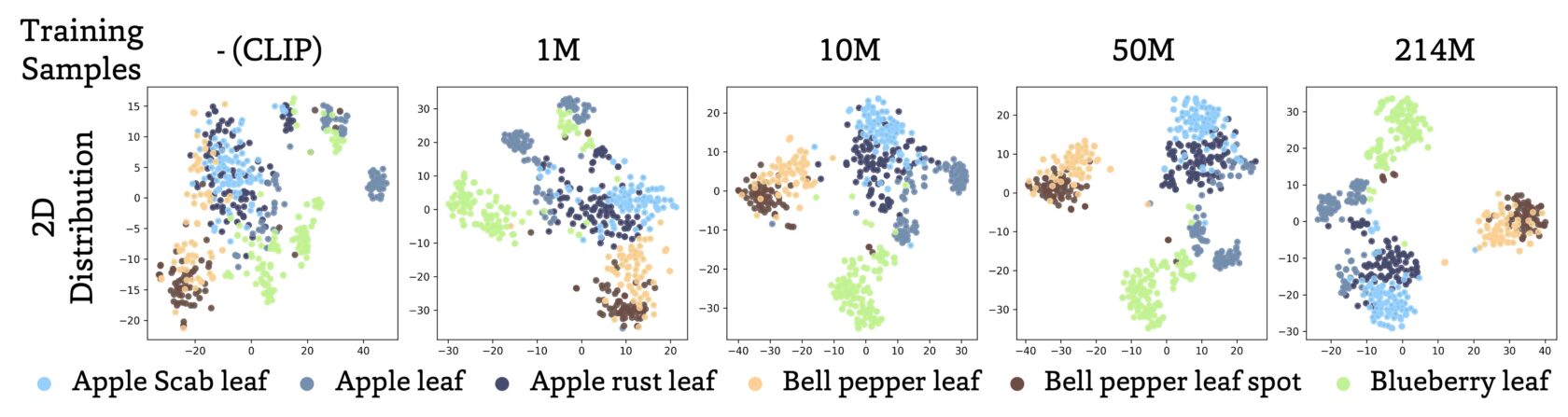
This model can even assess the health of various organisms based on training data. For example, it successfully separated healthy apple leaves from diseased ones and recognized different types of illnesses, as illustrated in a separate scatter plot.
To expedite the training, Berger-Wolf’s team deployed a total of 64 NVIDIA Tensor Core GPUs, allowing for efficient model development and inference. As Berger-Wolf notes, “Foundation models like BioCLIP would not be possible without NVIDIA accelerated computing.”
Wildlife Digital Twins: Envisioning Future Research
The forward-looking nature of this research doesn’t stop with BioCLIP 2. Berger-Wolf and her team are already laying the groundwork for an interactive wildlife digital twin. This ambitious project aims to visualize and simulate ecological interactions among species and their environment, providing a non-invasive way of studying these relationships.
By using a digital twin, researchers can visualize species interactions in context, allowing them to explore “what-if” scenarios and test models without disrupting the actual ecosystems. Berger-Wolf expresses excitement about this concept, envisioning a situation where a young visitor to a zoo could experience the world from a zebra’s perspective. “Imagine a kid at the zoo, and they can see the world through the eyes of another species. It opens up a new realm of understanding,” she says.
This digital twin technology has the potential to transform ecological research and could eventually reach public audiences through interactive exhibits at zoos, helping people gain a deeper appreciation for biodiversity and ecological relationships. Understanding these connections is vital, especially as we face pressing environmental challenges.
Learn more about BioCLIP 2.
Inspired by: Source


