


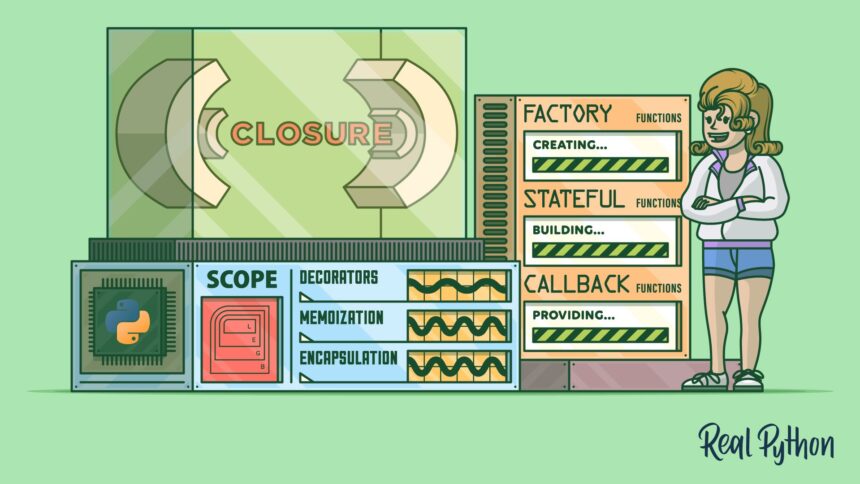
Understanding Closures in Python: A Dive into Functions Within Functions
In the world of Python programming, closures stand out as a powerful and fascinating concept. But what exactly is a closure? Simply put, a closure is a function defined inside another function that captures the environment in which it was created. This unique combination allows the inner function to access variables from its enclosing scope, even after the outer function has completed its execution. It’s a fundamental building block in Python that presents a range of practical applications, especially in functional programming.
What Are Closures?
Closures can be viewed as a blend of both a function and its surrounding state. When a nested function captures variables from its outer function, it maintains a reference to those variables even when the outer function has finished running. This behavior is what distinguishes closures from simple nested functions and makes them particularly useful in certain scenarios, such as creating decorators or callback functions.
Here’s a quick example to clarify the concept:
python
def outer_function(msg):
def inner_function():
print(msg)
return inner_function
closure_instance = outer_function("Hello, Closure!")
closure_instance() # Outputs: Hello, Closure!
In this example, inner_function is a closure that captures the variable msg from outer_function, enabling it to print the message even after outer_function has finished executing.
Use Cases for Closures in Python
Closures have a variety of applications that make them essential tools for Python developers. Here are some common use cases:
-
Function-Based Decorators: Closures can be instrumental in building decorators, which allow the addition of new behavior to existing functions. This is widely used in web frameworks like Flask or Django.
-
Data Hiding: By using closures, developers can create private variables that are not accessible from the outside, thus encapsulating the state and preserving its integrity.
-
Callback Functions: Closures can be leveraged to create callback functions that maintain state across calls, which can be particularly helpful in asynchronous programming.
- Memorization: You can use closures to store results of expensive function calls and reuse them when the same inputs occur, leading to enhanced performance.
Alternatives to Closures
While closures are powerful, they aren’t the only way to achieve similar outcomes in Python. Here are some alternatives you might consider:
-
Classes and Instances: Utilizing classes can also mimic the behavior of closures by keeping state in instance attributes. This approach can sometimes simplify code readability.
-
Global Variables: Though often discouraged, global variables can provide a way to maintain state across functions, albeit with risks concerning maintainability and side effects.
- Using Decorators Directly: Python also allows the creation of decorators without necessarily implementing closures. However, closures often make decorators more flexible and easier to manage.
What’s Included in This Course on Closures?
If you’re eager to delve deeper into the concept of closures, consider enrolling in a comprehensive video course designed for learners at all levels. Here’s what you can expect:
- 13 Lessons that guide you through the intricate workings of closures in Python.
- Video Subtitles and Full Transcripts for better comprehension and a richer learning experience.
- Downloadable Resources that complement the lessons, making it easier to revisit core concepts.
- An Accompanying Text-Based Tutorial providing an additional resource for self-study.
- An Interactive Quiz to check your progress and reinforce what you have learned.
- Q&A Sessions with Python Experts, giving you the opportunity to clarify your doubts and engage with seasoned professionals.
- A Certificate of Completion that you can showcase in your portfolio or resume.
Understanding closures enriches your Python programming knowledge and equips you with the skills to write more sophisticated and efficient code. Whether you’re creating decorators or simply looking to manage state effectively, mastering closures is an essential step in your programming journey.
Downloadable Resources
As you engage with this course, don’t miss out on the valuable downloadable resources designed to facilitate your learning. These materials are structured to reinforce the theoretical aspects and provide practical examples for implementation.
Exploring closures is not just an intellectual exercise; it’s a doorway into the more advanced features of Python that can elevate your code to new heights. So, are you ready to dive in?
Inspired by: Source


