


NVIDIA is setting a groundbreaking precedent with the launch of the world’s first optimized Ethernet networking paired with co-packaged optics to support AI factories. This innovative approach leverages the NVIDIA Rubin platform alongside the cutting-edge NVIDIA Spectrum-X Ethernet Photonics switch, establishing a new standard for multi-trillion-parameter AI infrastructure.
This blog post delves into the crucial optimizations and advancements in both the protocol and hardware of Spectrum-X Ethernet Photonics, highlighting their role in creating power-efficient, reliable, and resilient optical networks for giga-scale AI operations.
How Ethernet for AI Enables Scalable Training and Inference on the NVIDIA Rubin Platform
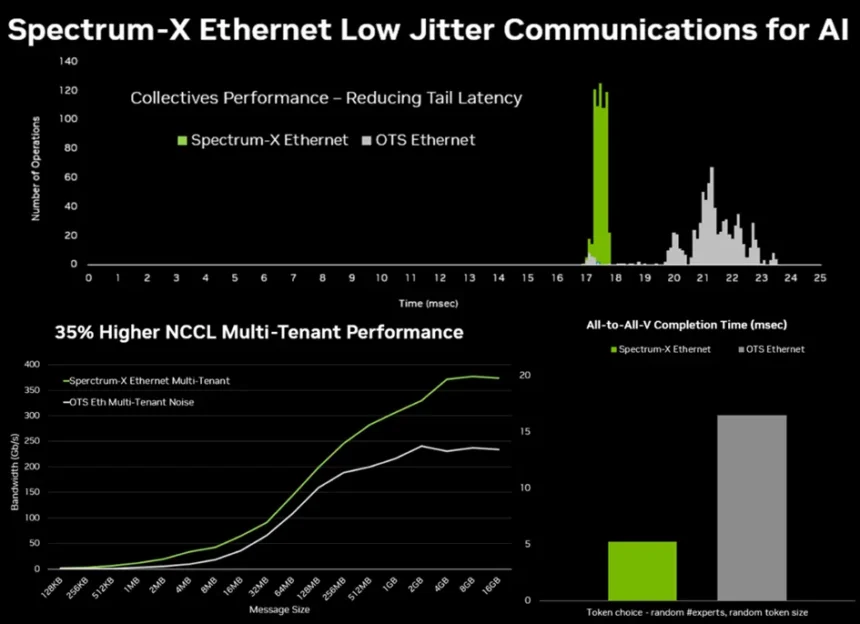
Ultra-low-jitter Ethernet networking is a cornerstone of scaling AI factories, ensuring consistent and dependable data transmission across the entire infrastructure. Reducing jitter translates into enhanced token throughput, which is indispensable for managing diverse, demanding workloads. This capability fosters seamless multi-tenancy, allowing multiple users and applications to operate concurrently without suffering from performance hiccups.
Furthermore, it boosts dispatch efficiency for models utilizing the Mixture of Experts (MoE) architecture. The result is faster expert selection, which markedly improves overall model performance, as illustrated in Figure 1. By enhancing speed, reliability, and scalability, AI factories achieve unparalleled operational efficiency.

Key Innovations in Spectrum-X Ethernet Photonics for AI Factory Optical Interconnects
The advances offered by the Spectrum-X Ethernet Photonics switch are pivotal for performance improvements in AI factories, thanks to its co-packaged silicon photonic engines.
- Innovative packaging and low-loss electro-optical channels provide a remarkable 5x power reduction per 1.6 Tb/s port compared to traditional pluggable interconnects.
- The co-packaged optical links enhance uptime, sustaining 5x longer link flap-free AI operation compared to standard Ethernet solutions, thus ensuring that AI workloads run smoothly.
- An impressive 10x improvement in network resiliency guarantees unmatched robustness for mission-critical applications.
With these innovations, organizations are empowered to scale their AI infrastructure significantly while enhancing performance per watt. This capacity allows them to undertake larger workloads without compromising on energy efficiency, reliability, and stability in network operations.

Notably, Spectrum-X Ethernet Photonics emerges as the world’s first fully integrated 512-lane, 200G-capable co-packaged switch system. The integration of detachable fiber connectors for surface-normal I/O represents a significant leap in the assembly and scalability of high-performance Ethernet switches for AI factories. This innovation allows optical fibers to be attached during the final stage of production, optimizing yield and throughput for large-scale deployments.
The surface-normal optical I/O architecture facilitates the scaling of optical ports without physically increasing the switch package size. This feature is critically advantageous for high radix switches, which require numerous connections in compact configurations to support extensive AI workloads.
Moreover, the solder-reflow compatible optical engine is a game-changer. It works seamlessly with modern test and assembly tools, enabling full screening of optical components before they are attached to switch silicon. This capability ensures that only proven high-quality engines are used, achieving a guaranteed 100% yield. The advanced process benefits from automation and comprehensive pre-assembly testing, paving a smooth manufacturing pathway for these sophisticated switch systems.
The integrated shuffle mechanism within the quad-ASIC switch architectures also facilitates flat and efficient scaling of GPUs within a single cluster. By avoiding latency usually caused by added switching layers, this topology ensures optimal performance even as clusters expand. With the SN6800 switch, users can enjoy a total bandwidth of 409.6 Tb/s spread across 512 ports of 800 Gb/s or 2,048 ports of 200 Gb/s, harnessing integrated fiber shuffle and co-packaged silicon photonics to create a compact, efficient Ethernet solution. These burgeoning innovations provide AI factories with robust network infrastructure, tailored for next-generation artificial intelligence applications.

What’s Next for AI Factory Networking Innovation
The holistic co-design approach encompassing chips, systems, software, and AI models is crucial for developing scalable, high-performance AI factories. With the introduction of Spectrum-X Ethernet Photonics switches, ultra-low jitter networking empowers AI factories to grow rapidly in speed, reliability, and scalability. This creates a robust infrastructure that can handle the demands of next-generation applications. For further insights, explore the NVIDIA Silicon Photonics page.
Inspired by: Source


