


Accelerating Quantum Simulations with NVIDIA cuQuantum
NVIDIA cuQuantum is a groundbreaking Software Development Kit (SDK) designed to accelerate quantum simulations at both the circuit (digital) and device (analog) levels. With its integration into the Quantum Toolbox in Python (QuTip) and scQubits, cuQuantum enables researchers and developers to streamline their workflows for designing and studying innovative qubit types. This revolutionary toolkit significantly enhances performance, making it easier than ever to explore the complexities of quantum systems.
- What is QuTip and Its Role in Quantum Simulations?
- scQubits: The Superconducting Qubit Modeling Powerhouse
- Transformative Speedups with cuQuantum
- Performance Insights for QPU Designers
- Scalable Solutions for Superconducting Qubits
- Easy Transition Between Packages
- Broadening the Scope of Quantum Research
- Getting Started with cuQuantum and QuTip
What is QuTip and Its Role in Quantum Simulations?
QuTip, or Quantum Toolbox in Python, is widely recognized for its robust capabilities in simulating the time evolution of open quantum systems. This versatile package allows users to configure novel qubit systems and analyze how these systems respond to various control pulses. QuTip empowers researchers to study qubit interactions with essential components like filters and resonators, and to calculate vital system parameters such as frequency shifts and transition energies. By leveraging QuTip, users can rapidly prototype device designs aimed at enhancing the performance of quantum technologies.
scQubits: The Superconducting Qubit Modeling Powerhouse
On the other hand, scQubits is a well-respected open-source Python package tailored for modeling superconducting qubits. Developed under the guidance of Jens Koch’s group at Northwestern University, scQubits focuses on providing researchers with tools to efficiently compute energy spectra based on physical parameters like capacitance and inductance. With its combination of user-friendliness and computational efficiency, scQubits has become a go-to resource for researchers at the forefront of quantum computing.
Transformative Speedups with cuQuantum
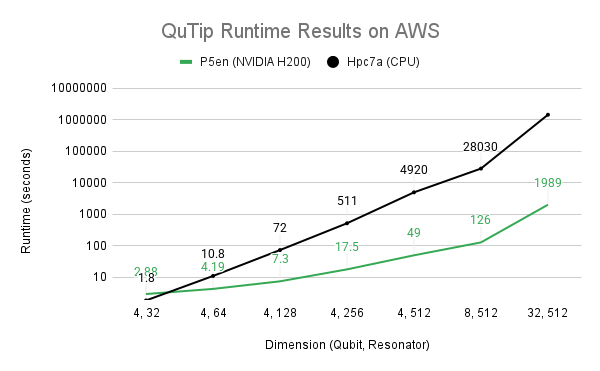
One of the most exciting developments stemming from the integration of cuQuantum is the introduction of the qutip-cuquantum plugin. Developed by Alexandre Blais’ research group at the University of Sherbrooke, this plugin delivers a staggering 4000x speedup when running simulations on an 8x GPU node hosted on AWS compared to traditional CPU-based systems. This drastic improvement allows the QuTip community to conduct simulations that were previously time-prohibitive and to tackle more complex quantum systems with confidence.
The multi-GPU and multi-node capabilities of the qutip-cuquantum plugin enable researchers to scale their simulations to larger Hilbert spaces, allowing for the examination of intricate quantum systems, such as a 64-state transmon qubit paired with a 512-state resonator. The assistance of NVIDIA’s P5en instance on AWS facilitates simulations that were thinkable only in theory, providing researchers with the needed power at their fingertips.
More Read

Figure 1. Results for the QuTip master equation solver on CPU and GPU accelerated by NVIDIA cuQuantum.
Performance Insights for QPU Designers
The availability of cuQuantum on AWS means that those interested in scaling QuTip simulations can access incredible computational power for their quantum dynamics simulation workloads. This opens new avenues for Quantum Processor Unit (QPU) designers and researchers, allowing for a deeper understanding of how complex dynamics impact qubit designs and their operational characteristics.
Scalable Solutions for Superconducting Qubits
Working alongside scQubits, NVIDIA has developed APIs within cuQuantum that efficiently accelerate this package. By integrating these enhancements, scQubits can now execute critical elements of the full qubit design workflow on NVIDIA GPUs. This efficiency is particularly evident in eigensolvers, which compute the energy spectra of superconducting devices—an essential step for new qubit design.

Figure 2. scQubits with cuQuantum running on NVIDIA DGX B200 GPUs shows a 54x speedup over advanced multi-threaded Intel Emerald Rapids CPUs.
Easy Transition Between Packages
Another significant advantage of integrating the outputs of scQubits with QuTip-cuQuantum is the seamless transition between modeling superconducting qubits and conducting analog quantum dynamics simulations. Designers can enhance their quantum devices’ coherence times, gate and readout performance, and overall throughput by leveraging GPU acceleration from both scQubits and QuTip.

Figure 3. The output from scQubits can be explored further in QuTip-cuQuantum, achieving remarkable speedups with NVIDIA GPUs.
Broadening the Scope of Quantum Research
With multi-GPU and multi-node execution capabilities embedded in both tools, researchers can delve into complex composite qubit systems, transcending the traditional single-qubit unit cells like fluxonium paired with a resonator. This broader spectrum of exploration promises to unlock valuable insights about how multi-qubit systems interact with one another, enriching the collective understanding of quantum dynamics.
Getting Started with cuQuantum and QuTip
For those eager to explore these powerful tools, installing the GPU-accelerated QuTip is straightforward. Simply use pip install qutip-cuquantum to begin harnessing the benefits of NVIDIA hardware for your quantum simulations.
Looking ahead, scQubits is on track to support cuQuantum capabilities, offering speedups far exceeding those achievable with conventional CPU resources. With version 24.09 now released, the optimal performance and scalability for quantum device designers are more accessible than ever. Researchers can find the latest packages on PyPI or Conda, easily installed via pip install cuquantum-python-cu13.
The advancement of cuQuantum redefines the landscape of quantum simulation, ensuring that researchers can rapidly optimize their designs and bring us closer to realizing the full potential of quantum computing.
Inspired by: Source


