


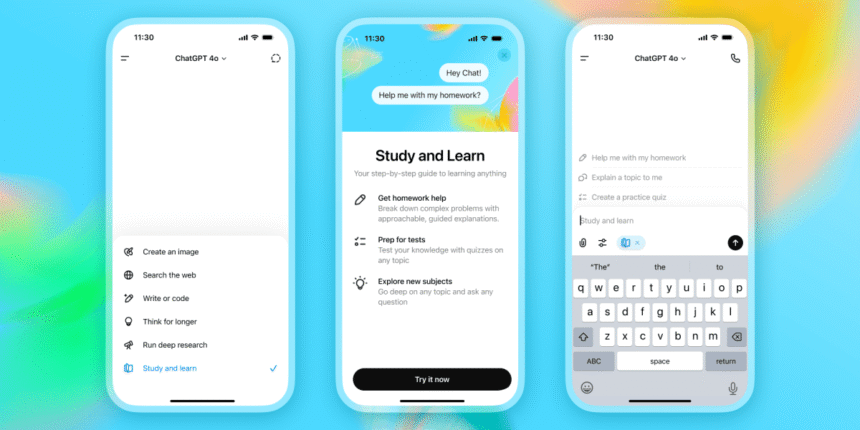
OpenAI’s Study Mode: Bridging the Gap in Education
A handful of college students from prestigious institutions such as Princeton, Wharton, and the University of Minnesota have recently voiced their positive experiences with OpenAI’s Study Mode. These students commend the tool for effectively assessing their understanding and adapting to their individual learning paces. But what exactly makes Study Mode stand out, and what are its implications for the future of education?
The Learning Approach of Study Mode
OpenAI has implemented various learning strategies in Study Mode, some of which are inspired by Socratic methods. According to Christopher Harris, an educator based in New York who specializes in AI literacy, these approaches are promising. He believes that they may provide educators with greater confidence in using AI as a learning aid rather than viewing it merely as a shortcut for students to bypass actual learning. "Professors will see this as working with them in support of learning," Harris states, highlighting a crucial aspect of this technology’s potential.
A Vision for Personalized Learning
OpenAI’s ambitions extend beyond simple academic support. The organization is making strides in redefining chatbots—as seen in their recent collaboration with leading teachers’ unions—as tools for personalized learning experiences. This initiative represents a shift from the notion of AI as a tool for academic dishonesty to one that offers individualized instruction similar to that of expensive human tutors. Leah Belsky, head of education at OpenAI, emphasizes this transformative goal, stating, "We can begin to close the gap between those with access to learning resources and high-quality education and those who have been historically left behind."
The Reality of AI Learning Tools
However, while the vision for Study Mode is compelling, it is essential to scrutinize its foundations. The technology behind Study Mode isn’t solely based on vetted academic resources. In fact, it’s quite similar to ChatGPT but is fine-tuned with a conversation filter designed to promote dialogue that encourages deeper understanding. This means that the AI may source information from a vast array of online platforms, including forums like Reddit and Tumblr, where misinformation can easily be found.
Potential Risks of AI Tutoring
This brings us to a critical concern. While Study Mode offers a way to interact with learning material, it also poses risks. Professors who advocate for the use of this AI tool may inadvertently expose their students to erroneous information or misleading explanations. Imagine hiring a tutor who has read all the required textbooks, yet also consumed every flawed explanation available on the web. That’s akin to what students are up against with Study Mode.
More Read

Navigating Misinformation
The challenge lies in the AI’s inability to differentiate between valid and invalid information. Students could unintentionally adopt incorrect problem-solving approaches or, worse, learn material that is entirely fabricated. This highlights the importance of maintaining academic rigor and ensuring that AI tools supplement—not replace—traditional educational methods.
Enhancing Graduate Success
Despite the potential pitfalls, the dialogue surrounding Study Mode is vital as it encourages an evolving understanding of AI in education. When used responsibly, these tools could eventually enhance the learning experience, making high-quality education more accessible. By fostering a culture of responsible usage and critical thinking, students can learn to navigate AI resources while still upholding academic integrity.
With a focus on innovative learning methods, the educational community can better prepare for the integration of technology. As conversations about AI evolve, so too must our approaches to teaching and learning, ensuring that the next generation is well-equipped to tackle both opportunities and challenges in an increasingly tech-driven educational landscape.
Inspired by: Source


