


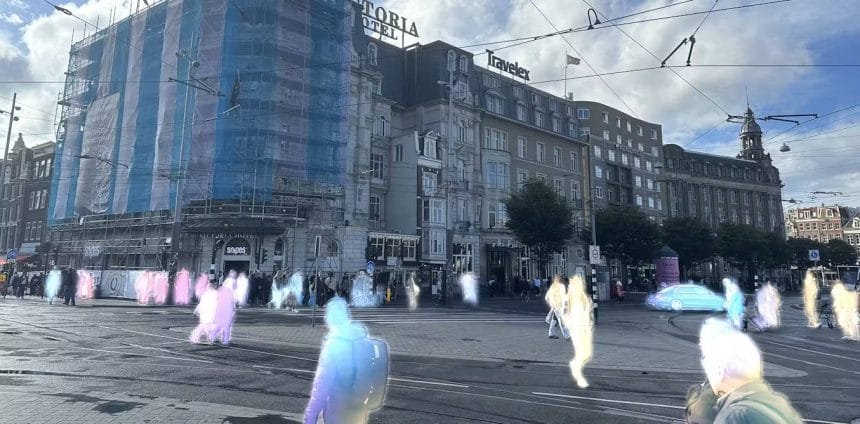
Exploring Apple’s New Clean Up Feature: A Game Changer in Photo Editing
You may have recently encountered advertisements from Apple showcasing its innovative Clean Up feature, designed to help users eliminate unwanted elements from their photos. Intrigued by this functionality, I updated my software over the weekend to give it a whirl. What I discovered is not only impressive but also raises important questions about the future of photography and digital authenticity.
Availability and How It Works
The Clean Up feature has been accessible in Australia since December for Apple users with compatible hardware and software. It’s now also available in New Zealand, Canada, Ireland, South Africa, the United Kingdom, and the United States. This tool utilizes generative artificial intelligence (AI) to analyze images and identify distracting elements, which are highlighted in red for easy removal.
The process is straightforward: users can tap on the highlighted objects or circle elements they wish to remove. The device then employs generative AI to fill in the gaps by creating a logical replacement based on the surrounding area. This seamless integration allows users to enhance their photos without needing to download and learn a separate app, making advanced editing more accessible than ever.
The Rise of AI in Photo Editing
Smartphone photo editing has evolved significantly over the last decade. With tools like Apple’s Clean Up, users no longer need to rely on third-party applications to achieve professional results. Similar AI-driven features are available on Android devices, such as Google’s Magic Editor, which allows users to move, resize, recolor, or remove objects. Samsung users also benefit from built-in functionalities to edit their photos directly from the gallery app.
However, the ease of use of these tools raises concerns about the ethical implications of photo manipulation. While editing has always existed, the integration of AI into everyday photo editing software simplifies the process, possibly leading to misuse.
More Read

Ethical Considerations and Trust Issues
As we embrace these advanced photo editing tools, we must consider the implications on trust and authenticity in photography. From police body cameras to insurance claims, we depend on the reliability of visual evidence. The ability to easily manipulate images calls into question the integrity of photographic proof. If we cannot trust what we see, we must reconsider what it means to have visual evidence of an event.
While the Clean Up feature aims to enhance user experience by removing distractions—such as tourists from a crowded landmark—this capability can also be misused. For instance, some individuals might employ these tools to erase watermarks from images, undermining the work of photographers seeking to protect their intellectual property. Others might alter evidence in a way that misrepresents the condition of goods being sold.
The Spectrum of Use Cases
The potential applications of photo editing tools like Clean Up extend far beyond simple enhancements. The ability to remove distractions can be appealing for personal use, allowing users to create stunning images that focus on the subject matter. However, as these tools become more accessible, they may also be used for less honorable purposes, such as creating realistic fake receipts or modifying evidence in deceptive ways.
As AI technology becomes more advanced, so too does the range of applications. The potential for misuse is significant; with the ability to generate convincing images and documents, the line between reality and fabrication blurs.
Navigating the New Landscape of Visual Proof
Considering the advancements in image editing technology, the question arises: Can we trust anything we see anymore? While zooming in on edited images may reveal inconsistencies—where the AI has not quite matched the surrounding context—this method isn’t foolproof. Therefore, it becomes increasingly important to adopt verification strategies, such as requesting multiple images from different angles to assess authenticity.
In addition to visual checks, conducting background research can be invaluable. For instance, if presented with a potentially fake receipt, one might inquire whether the establishment exists, if it was operational on the claimed date, or if the listed items were available on the menu. These investigative approaches may take time, yet they’re crucial in an age where digital deception is growing.
The Role of Regulation and Future Implications
With the rise of AI’s capabilities in photo editing, regulatory measures are essential to mitigate misuse. In the European Union, for example, Apple encountered delays in rolling out its Apple Intelligence features, including Clean Up, due to regulatory uncertainties. As technology continues to evolve, finding a balance between innovation and ethical usage will be paramount.
In summary, while AI-driven tools like Apple’s Clean Up can simplify photo editing and enhance creativity, they also bring complex challenges surrounding trust and authenticity. As users, being aware of these capabilities and their implications is vital for navigating our increasingly digital landscape. Developing visual and media literacy will empower individuals to discern the truth in a world where images can be effortlessly manipulated.


