


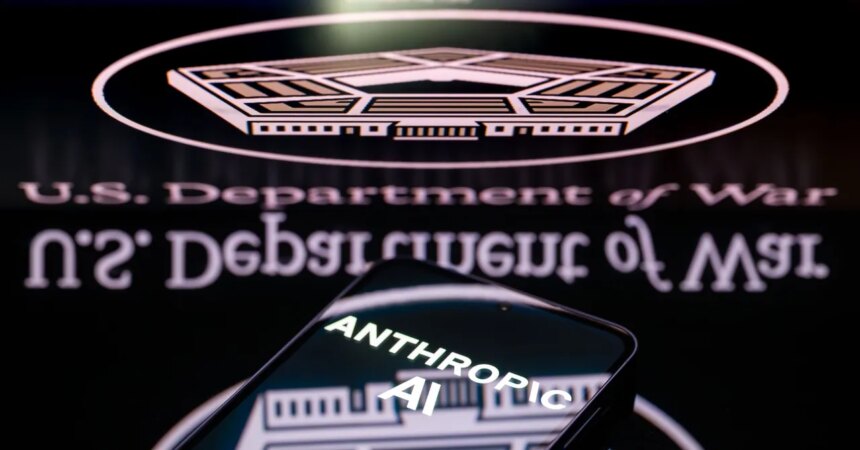
Anthropic vs. the Trump Administration: A Legal Battle Over AI Regulation
The ongoing legal dispute between Anthropic, the AI startup, and the Trump administration highlights significant issues surrounding national security, government contracts, and the implications of artificial intelligence technology. Recently, a court filing from the Trump administration asserted that it did not violate Anthropic’s First Amendment rights by labeling the company as a supply-chain risk. This designation has far-reaching implications for Anthropic’s ability to secure government contracts, and the backdrop of the case illustrates the complexities of regulating emerging technologies.
- The Core Issue: First Amendment Rights
- Anthropic’s Claim: Overstepping Authority
- Urgency for Immediate Relief
- Claims of Irreparable Harm
- Concerns Over AI Safety and Integrity
- The Ongoing Struggle Over AI Models
- Legal Opinions on Retaliation Claims
- Future of AI Partnerships
- Support from the Tech Community
- Next Steps in the Legal Battle
- AI and National Security: A Complex Relationship
The Core Issue: First Amendment Rights
In their legal argument, U.S. Department of Justice attorneys contended that the First Amendment does not allow companies to unilaterally impose contract terms on the government. By designating Anthropic as a supply-chain risk, the administration is taking steps to protect national security without infringing on the company’s rights to express its opinions. The government thus aims to frame its actions as necessary precautions rather than an overreach of authority.
Anthropic’s Claim: Overstepping Authority
Anthropic argues that this designation is an unwarranted abuse of power. The company believes that the Trump administration’s action prevents its technologies from being utilized within the Department of Defense. If the designation remains in place, Anthropic could face considerable financial loss, potentially up to billions in revenue—even as it asserts the importance of its advanced AI technology in promoting national security.
This claim aims to position Anthropic as not just a tech developer, but also as a crucial player in the defense landscape, capable of contributing positively to government operations.
Urgency for Immediate Relief
Anthropic’s legal team is pushing for a swift resolution to continue normal business operations while the case is being litigated. Judge Rita Lin, presiding over the San Francisco case, has set a hearing for next Tuesday to deliberate whether Anthropic can obtain such temporary relief. For the company, a favorable ruling could mean retaining critical government contracts and revenue streams.
More Read

Claims of Irreparable Harm
In its court documents, the Department of Justice dismissed Anthropic’s worries about potentially losing business as “legally insufficient to constitute irreparable injury.” This framing indicates that the government is prepared to downplay the financial implications for Anthropic in favor of national security concerns. The administration posits that giving Anthropic access to government technology could pose threats, as they could potentially manipulate their own AI models.
Concerns Over AI Safety and Integrity
The legal filing raised alarms about Anthropic’s potential future conduct. The Defense Secretary’s concerns included fears that Anthropic’s staff might sabotage technologies or compromise national security systems. This perception paints Anthropic not only as a contractor but as a potential risk to U.S. military operations, thereby justifying stringent oversight.
The Ongoing Struggle Over AI Models
One significant focus of the dispute is Anthropic’s Claude AI models, which the Pentagon has categorized as unreliable for use in full autonomous operations. Anthropic, however, disputes that these models should be harnessed for extensive surveillance or warfare. The company maintains its commitment to ethical AI development, stressing that its technologies should not be used in harmful ways.
Legal Opinions on Retaliation Claims
Legal experts have weighed in on Anthropic’s claims, suggesting that the supply-chain designation could be interpreted as retaliation against the company. Yet, historical precedent shows that courts often favor the government’s national security arguments, which complicates Anthropic’s chances in court. Pentagon officials have characterized the startup as having “gone rogue,” further undermining its credibility in legal arguments.
Future of AI Partnerships
As the Department of Defense seeks alternatives to Anthropic’s technology, it plans to transition to AI systems from competitors like Google, OpenAI, and xAI. This shift not only underscores the urgency of the situation but poses questions about the future landscape of AI in military applications. The government has signaled its readiness to replace Anthropic’s services swiftly, which would mark a significant shift in the U.S. defense technology narrative.
Support from the Tech Community
Interesting dynamics are unfolding as various stakeholders within the tech community express support for Anthropic. Companies, AI researchers, and even former military leaders have submitted court briefs backing Anthropic’s position, demonstrating a broader concern over the implications of restricting innovative AI technologies. This collective support adds an intriguing layer to the battle, suggesting that many in the tech world view the case as a pivotal moment for AI governance.
Next Steps in the Legal Battle
With Anthropic needing to file a counter-response to the government’s arguments by Friday, the legal back-and-forth is set to continue. This case not only embodies the struggle between emerging technology and regulatory frameworks but also raises broader questions about freedom, innovation, and security in an increasingly AI-driven world.
AI and National Security: A Complex Relationship
Ultimately, the conflict highlights the delicate balance that must be struck between advancing AI technology and safeguarding national security. As courts decide the fate of this high-stakes legal battle, the implications will reverberate across the technology sector and government policy for years to come.
Inspired by: Source


